Indian processed food industry continues to grow, but investment gaps constrain its global competitiveness. Rajat K Baisya examines FDI trends, domestic investment, the PLI scheme and the need to strengthen technology, capacity expansion and MSMEs across the food processing value chain.
Indian processed food sector has grown at an average annual growth rate (AAGR) of 7.26% to 7.3% over recent years, with Gross Value Added (GVA) rising from ₹1.34 lakh crore in 2014-15 to ₹2.24 lakh crore in 2023-24. The global food industry is growing at a CAGR of 6.2%. However, in terms of value addition, our achievement is around 10%, although the target rate of growth is 25-30%. We thus have a long way to go.
This is the reason why we are still not globally competitive and are unable to compete in the global market. The Indian food processing industry is estimated to be about US$382.24 billion in 2025, while the global market size is said to be US$8.2 trillion. In no way can India emerge as a global manufacturing hub for the processed food industry if we cannot improve our competitiveness.
Indian Processed Food Exports: Growth and Global Market Leadership
Although processed food exports expanded their share in total agricultural exports from 13.7% in 2014-15 to 20.4%, crossing historical milestones such as US$25.6 billion in total exports during FY22, India still reported around 1%, as against 2% during the 90s, as our contribution to global trade in processed foods.
In many primary foods, we are the number one producer, but we are not the best or top performer in global trade. For example, we have now also achieved the global number one position in dairy milk production, but we are still not able to export skim milk powder. We are not able to add higher value to become competitive.
Value is defined as benefits by cost. As such, we can increase value either by increasing benefits or decreasing cost, or both. In spite of the fact that our labour cost is low, we are not cost-competitive.
The problem starts with agricultural practices themselves, as our farm-level productivity is among the lowest. We need to address this issue, which will also improve farmers’ income, which the government always promises but is never able to deliver.
Secondly, we need to achieve scale of operation, which again is linked to the market demand that we can generate.
Thirdly, we have to eliminate non-value-adding activities and also incorporate value-adding activities into business processes, to be established through value chain analysis in the end-to-end supply chain.
Investment in Technology, Modernisation and Scale
For all this, we need to have a growth investment programme. There are many aspects of industry practices that have improved, and logistics and infrastructure have also improved. So why are we still not globally competitive in improving our growth trajectory in the international trade of processed food products? Something is not going right since the formation of the Ministry of Food Processing Industry.
The Ministry of Food Processing Industry was set up for the first time in 1988, when Rajiv Gandhi was India’s Prime Minister. The objective of setting up an independent ministry for food processing was to promote and develop the food processing sector in India and also to make India a global manufacturing hub for processed food products.
Rajiv Gandhi is also credited with setting up, for the first time, a Ministry of Human Resource Development, replacing the Ministry of Education, which had been there since independence. Rajiv Gandhi created the HRD Ministry in 1985, and three years later, in 1988, he set up MoFPI.
He rightly thought about the development of people first. Then he focused on agriculture, as more than 30% of the country’s economy was dependent on the performance of the agriculture sector alone at that time.
And agriculture is the backbone of the processed food industry in the sense that quality raw material at a competitive price is a prerequisite for the competitiveness of this sector.
During the late 80s, about 65-70% of our population used to depend on agriculture, which has come down to 45-50% now. In 1988, the contribution of Agriculture to our GDP was around 30-32%, and today that contribution has come down to about 15-16%.
Even the manufacturing sector’s contribution to GDP is around 16-17% now. This indicates that while dependence on agriculture for livelihood has come down by around 20%, the contribution of agriculture to the economy has come down by almost 50%.
Food Processing’s Contribution to India’s Manufacturing Economy
Food processing contributes about 14% of the manufacturing GDP, and if manufacturing GDP is 16%, the processed food industry contributes only 2.24% of the GDP.
The key drivers of the growth of the processed food industry in India, as is often talked about, include Rapid urbanization, changing lifestyle, Disposable Income, Government support, Technology Intervention, Demography, Product Innovation, E-commerce and Quick Commerce, Infrastructure like cold storage and cold chain, vast domestic market, modern trade, and organized retailing.
However, our domestic consumption has not yet grown in relation to the opportunities that we have. Our processed food consumption can only increase if the cost comes down significantly in relation to fresh. Besides, our corporate growth investment program has to cover the MSME processing sector as well, which is not happening.
Domestic Investment in Private Sector
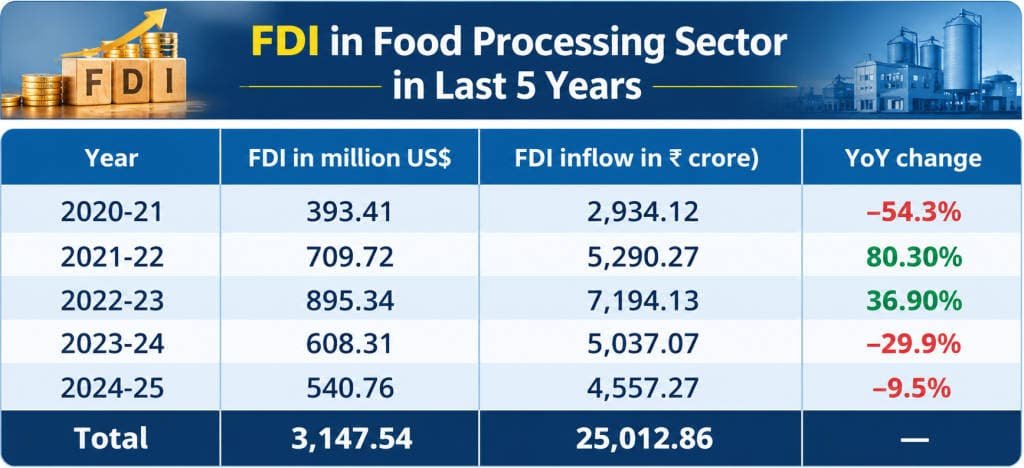
FDI is not the only component of the growth investment story. Domestic private companies, cooperatives, MSMEs, and Indian subsidiaries of multinational companies are making substantial investments as well. As can be seen, domestic private sector investment is limited to certain sectors. And only large players are investing, taking advantage of the govt’s Production Linked Incentive (PLI) program.
A. Dairy – one of the strongest investment areas
Amul / Gujarat Cooperative Milk Marketing Federation: Amul has been among the major participants in the food-processing PLI programme, particularly in value-added dairy. Its investment programme encompasses expansion of processing capacity and products such as cheese and other value-added dairy products. The government identifies Amul among the major corporate/cooperative investors under the PLI scheme.
Milky Mist: A particularly interesting private-sector example is Milky Mist, which has been expanding aggressively into yoghurt, ice cream, paneer, cheese and other value-added dairy products. Its recent expansion illustrates the movement of private capital away from basic milk processing towards higher-value products.
B. Packaged food / snacks / breakfast foods
ITC: ITC has invested substantially in expanding its food portfolio, including packaged foods, snacks, staples and newer health-oriented products. A particularly important development is its acquisition and subsequent investment in Sprout Life Foods/Yoga Bar.
ITC initially invested ₹175 crores for 39.4% of Yoga Bar in 2023 and subsequently increased its stake; in September 2026 it acquired the remaining 52.5% for ₹645 crores. This represents private investment in the health/breakfast/functional packaged-food segment, rather than conventional food manufacturing alone.
C. Ready-to-eat / ready-to-cook foods
Companies such as Nestlé India, Britannia, ITC, Tata Consumer, Haldiram and Hindustan Unilever have invested in capacity expansion and product development in convenience and packaged-food categories. PLI is a good scheme. However, MSMEs and export-oriented industries in the food processing sector should be encouraged to derive benefit from it. In addition, we need investment in technology, modernization, and capacity expansion of the smaller players across categories to happen in the entire value chain.
About the Author: Dr. Rajat K Baisya is Chairman of Strategic Consulting Group and former Professor and Head of the Department of Management Studies at IIT Delhi. His expertise spans marketing, strategy, project management and international business. He is also President of the Project & Technology Management Foundation. He can be reached at rkbaisya@hotmail.com.

Have a news or topic to share with industry? Write to us editorial@pfionline.com