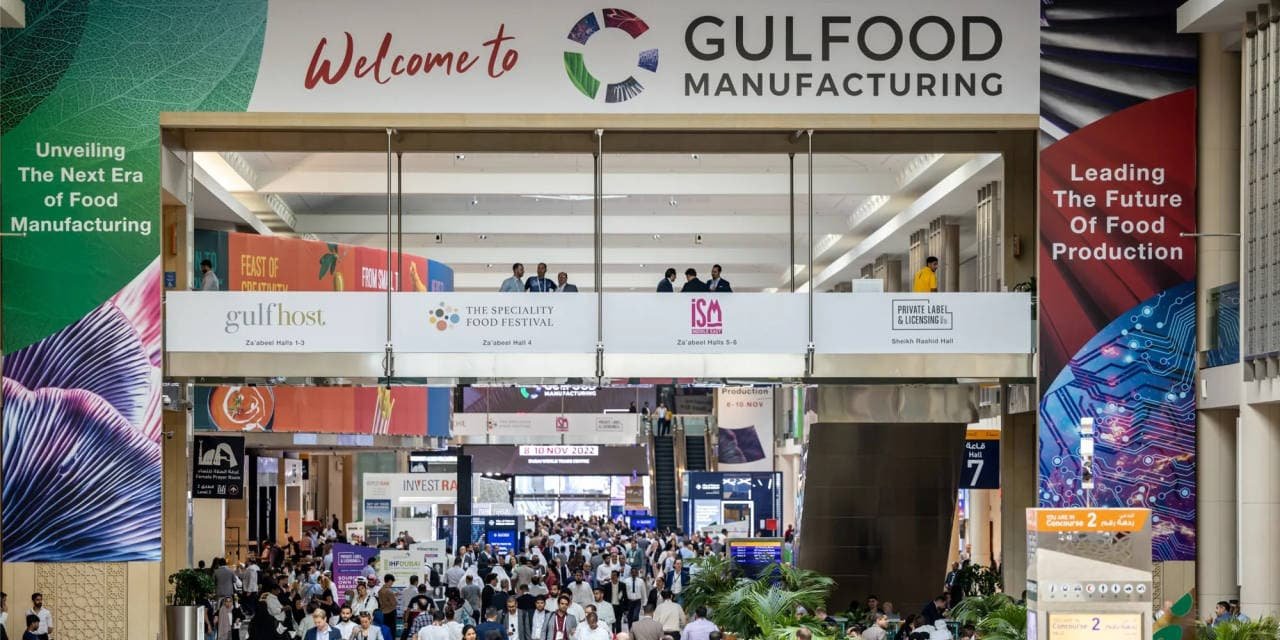
Gulfood Manufacturing 2026 returns to Dubai from 3-5 November, showcasing food processing, packaging, ingredients, automation and digital manufacturing technologies, as the UAE strengthens domestic food manufacturing.
Final preparations are under way for Gulfood Manufacturing 2026, which will bring food and beverage manufacturers, technology providers and ingredient suppliers to Dubai from 3-5 November. The event is expected to showcase advances in processing, packaging, automation and supply chain management at a time when food security, production efficiency and domestic manufacturing capacity are gaining importance across the Middle East.
Despite ongoing geopolitical tensions in the region, organisers are planning for the exhibition to proceed as scheduled. The event will provide a meeting point for international suppliers and regional manufacturers seeking new technologies, business partnerships and opportunities to expand production.
Held at the Dubai World Trade Centre, Gulfood Manufacturing is positioning its 2026 edition around the role of manufacturing innovation in strengthening food security. The focus reflects the UAE’s broader ambitions to increase domestic production, reduce reliance on imported food products and develop a more resilient food supply chain.
According to figures cited by the organisers, the UAE aims to achieve AED 2 billion in annual food import substitution through local production, support up to 200 food factories and increase domestic production capacity by 15-30%. These targets underline the potential for investment in processing equipment, packaging systems, ingredients, automation and related manufacturing technologies.

Building a stronger food manufacturing base
The UAE is seeking to expand its industrial capabilities through investment in advanced technology, local production and more resilient supply chains. Gulfood Manufacturing 2026 is intended to support these objectives by bringing manufacturers, ingredient specialists, equipment suppliers and industry decision-makers together.
Mark Napier, vice-president of Gulfood Manufacturing, said stronger manufacturing capacity was central to the UAE’s food security and economic ambitions. Greater production capability, he noted, could support local manufacturing, attract investment, speed up technology adoption and strengthen the supply chains underpinning the food economy.
He also highlighted Dubai’s position as an international trade hub, connecting regional manufacturers with global investors, technology providers and supply chain partners. The exhibition and its co-located platforms are designed to help businesses establish partnerships, assess new technologies and develop the capabilities required for future growth.
For food processors, this creates opportunities to examine production systems that can improve throughput, reduce waste, maintain consistent product quality and support changing consumer demand. The business case extends beyond capacity expansion. Manufacturers must also manage energy and water use, raw material costs, food safety and increasingly demanding product specifications.
The wider region also has room to develop products tailored to local tastes, cultural preferences and dietary needs. This creates demand for specialised processing systems, flexible packaging formats and ingredient solutions that can support product differentiation while maintaining commercial efficiency.
Major suppliers prepare to showcase technology
The exhibition is expected to feature a broad cross-section of the global food manufacturing supply chain, from processing and packaging machinery to ingredients, logistics and digital systems.
Among the equipment and packaging companies listed for participation are GEA, Heat and Control, Husky, Ishida, KHS, Krones, Middleby, Multivac, SIG, Sidel, Tetra Pak and TNA. Their areas of expertise span processing, filling, inspection, weighing, packaging and production line integration.
Ingredient suppliers expected to take part include ADM International, Bunge, Cargill, Palsgaard, Döhler, dsm-firmenich, Givaudan, IFF, IFFCO, MANE and Symrise. Their portfolios cover ingredients and solutions used in product formulation, flavour development, texture control, preservation and other aspects of food manufacturing.
National pavilions will provide another route for companies to reach buyers and distributors. British businesses expected to be represented include BCH equipment, DC Norris, Silverson Machines, Sugden processing equipment and Tate & Lyle.
Supply chain and automation specialists, including ACME, Addverb, Delta Systems and Kanoo Machinery, are also expected to present technologies intended to improve the movement, handling and distribution of food products.
Together, these exhibitors reflect the growing links between processing performance, packaging design, ingredient selection and supply chain efficiency. For manufacturers assessing new investments, the ability to integrate these elements into a reliable production system is becoming increasingly important.
Automation, digital manufacturing and ingredients in focus
The three-day exhibition will focus on advanced processing and packaging, next-generation ingredients, robotics, automation, artificial intelligence, digital manufacturing, traceability, cold chain management and predictive planning.
These technologies address practical challenges within the factory environment. Automated inspection and handling can help improve consistency and reduce dependence on manual operations. Digital monitoring can provide better visibility into production performance, while predictive maintenance can help limit unplanned downtime. Improved traceability systems support quality assurance, product recalls, and compliance with food safety regulations.
Packaging technology is another key area, especially as manufacturers seek packaging formats that protect products, extend shelf life, and reduce material usage without compromising performance. Advances in filling, sealing, inspection and line control can help processors improve output while maintaining product integrity.
Ingredient innovation will also be an important part of the exhibition. Visitors can expect solutions across colour additives, emulsifiers, enzyme preparations, essential oils, flavours and aromas, preservatives, stabilisers, starches, sugars, sweeteners and yeast.
For food manufacturers, ingredient selection has implications beyond taste and product appeal. It can affect processing conditions, yield, shelf life, product consistency, labelling requirements and overall production costs. Suppliers are therefore expected to address the combined demands of formulation performance, cost control and consumer acceptance.
Industry figures point to international reach
The previous edition provides an indication of the exhibition’s scale. According to the organisers, it attracted 61,907 industry professionals and more than 2,500 exhibitors, with participants from 79 countries and activity spread across 21 exhibition halls.
Organisers also reported a 31% expansion in the show’s overall scale and 35% growth in international attendance. These figures point to the event’s expanding role as a sourcing and business development platform for regional manufacturers and international suppliers.
The international participation is particularly relevant for food processors seeking access to specialised equipment, new ingredients and technical expertise that may not be readily available in their domestic markets. For overseas suppliers, the event offers a route to engage with buyers across the UAE and the wider Middle East, Africa and South Asia.
Foodtech Summit adds an industry knowledge programme
Alongside the exhibition, the three-day Foodtech Summit will provide a forum for discussions on manufacturing trends, technology adoption and the future of food production. The announced speaker line-up includes representatives from major businesses such as Mars, Ferrero and Givaudan, alongside technology companies including Bühler.
The programme is expected to complement the exhibition by connecting commercial priorities with developments in manufacturing, product innovation and supply chain management. For processors, such discussions can help identify emerging investment needs and practical responses to changing market conditions.
As manufacturers across the region work to strengthen domestic production, improve operational performance and meet evolving consumer expectations, Gulfood Manufacturing 2026 will offer a platform to assess the technologies and partnerships shaping the next phase of food manufacturing. The central challenge for the industry is to turn innovation into measurable results: higher productivity, reliable product quality, lower waste and stronger supply chains. These priorities are likely to remain central to investment decisions well beyond the three days of the Dubai exhibition.

Have a news or topic to share with industry? Write to us editorial@pfionline.com