
Complete FSSAI compliance guide for Indian food businesses. Covers licensing, labelling, inspections, penalties, and 2026 regulatory updates. Download free checklist. While the overall subject is broad, the individual articles, linked here, offer deeper insights into specific technologies, applications, and industry trends.
FSSAI enforcement is becoming more intensive. In 2025-26, authorities conducted 5,20,566 inspections of food businesses across India, up from 4,01,391 the previous year, and analysed 2,23,808 food samples. Of these, 40,023 were found non-conforming – nearly one in five samples.
The consequences are significant. Over the last five years, 4,461 licences were suspended and 11,493 cancelled. In Andhra Pradesh, 16 food establishments faced penalties totalling ₹5.65 lakh for violations ranging from operating without valid licences to selling expired products. The message is clear: FSSAI compliance is a core business requirement, not a formality.
Table of Contents
This guide brings together the key FSSAI compliance requirements businesses need to understand in 2026. It covers licensing, FoSCoS applications, labelling, packaging, inspections, penalties and common compliance questions – from home bakers and cloud kitchens to restaurants and large manufacturers.
What This Guide Covers
- FSSAI registration vs. licence – which category applies to your business
- The licensing process through FoSCoS
- Mandatory labelling declarations and front-of-pack warning labels
- New packaging requirements for 2026
- Inspection requirements and preparation
- Penalties for non-compliance
- Frequently asked questions
Step 1: Understanding FSSAI and Your Legal Obligations
What is FSSAI and Who Needs to Comply?
The Food Safety and Standards Authority of India (FSSAI) is the statutory authority established under the Food Safety and Standards Act, 2006. Its mandate is to lay down science-based food standards and regulate the manufacture, storage, distribution, sale and import of food to ensure safe and wholesome food for human consumption.
Who is a Food Business Operator (FBO)?
An FBO is any person who carries on or owns a food business, regardless of scale. This includes home bakers and cloud kitchens, street vendors and small dhabas, restaurants and hotels, packaged food manufacturers, distributors and retailers, importers and exporters, and e-commerce platforms selling food.
The law applies irrespective of whether the business operates for profit. Selling through Instagram, WhatsApp or another digital platform does not exempt a business from compliance. The obligation is linked to the food business activity, not the sales channel. Food Business Operators’ Rights and Duties Under FSSAI
FSSAI Registration vs. Licence: Which Do You Need?
The applicable registration or licence category depends primarily on annual turnover and the nature of the activity. FSSAI revised the turnover thresholds with effect from 1 April 2026, reducing the compliance burden for many small businesses.
Revised Turnover Thresholds – Effective 1 April 2026
- Basic Registration: Up to ₹1.5 crore. Typical businesses include street vendors, home bakers, micro enterprises and small dhabas.
- State Licence: ₹1.5 crore to ₹50 crore. This covers many small-to-medium restaurants, regional manufacturers and distributors.
- Central Licence: Above ₹50 crore. This generally covers large manufacturers and certain businesses whose activities require a Central Licence.
Key Change
The Basic Registration ceiling has increased from ₹12 lakh to ₹1.5 crore. As a result, many street vendors, home-based businesses and small eateries that previously required a State Licence may now fall under the simpler Basic Registration category.
Who Needs a Central Licence Regardless of Turnover?
Certain businesses require a Central Licence irrespective of turnover, including importers, 100% export-oriented units, e-commerce operators and businesses operating in multiple states.
One Premise, One Licence
One FSSAI registration or licence is required for each premise. If manufacturing and storage activities are carried out at the same location, one licence can cover the activities there. Separate premises require separate registrations or licences. This is particularly relevant to businesses operating production and retail facilities from different locations. See our bakery FSSAI compliance guide for how this applies in practice.
Step 2: The FSSAI Licensing Process – Step by Step
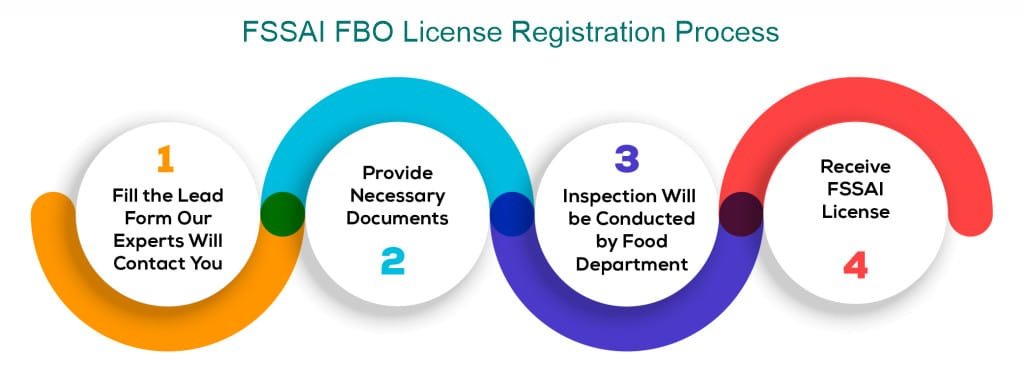
How to Apply Through FoSCoS
FoSCoS is the digital portal for FSSAI registrations, licences and related applications. For first-time applicants, the step-by-step FSSAI registration process guide provides a detailed walkthrough, while All About FSSAI Registration offers a quick overview.
Stage 1: Create User Account – Register on FoSCoS with a valid email address and mobile number.
Stage 2: Select Licence Type – Determine whether Basic Registration, State Licence or Central Licence applies, based on turnover and business activity.
Stage 3: Complete Application – Use Form A for Basic Registration and Form B for a State or Central Licence. Provide complete business details, including address, nature of business and product categories.
Stage 4: Upload Documentation – Typical documents include identity proof, proof of premises, a layout plan of the processing unit, equipment and machinery details, a water test report for manufacturing units, and an NOC from the local municipality where applicable.
Stage 5: Pay Fees – Fees vary by licence category and are payable online. The payment generates a Unique Application Reference Number (UARN).
Stage 6: FSSAI Review – FSSAI reviews the application and may request clarification. Respond within the specified period to avoid rejection.
Stage 7: Premises Inspection – For most State and Central licences, a food safety officer may inspect the premises to verify hygiene, infrastructure and storage practices.
Stage 8: Grant of Licence – Once approved, the business receives a 14-digit FSSAI licence number, which must be displayed prominently at the premises and printed on product packaging.
For common questions on documents, timelines and eligibility, see FAQs on FSSAI Registration and FSSAI License.
Perpetual Validity: What Changed in 2026
From 2026, FSSAI licences and registrations no longer carry expiry dates. They remain valid unless suspended, cancelled or surrendered.
This removes the need for periodic renewal applications and document uploads at renewal. However, annual fee payment remains mandatory. Before migrating to the perpetual-validity system, FBOs must complete one standard renewal under the earlier process.
Annual Fee Penalties for Late Payment
- 1-90 days: 3× the annual fee.
- 91-180 days: 5× the annual fee.
- After 180 days: renewal is not permitted and a fresh licence is required.
For example, a Central Licence with a base annual fee of ₹7,500 delayed by six months would require payment of ₹45,000.
Annual Returns: Mandatory for State Licence Holders
With the revised turnover thresholds, State Licence holders – covering businesses in the ₹1.5 crore to ₹50 crore bracket – are subject to annual return filing obligations that previously applied mainly to Central Licence holders.
FoSCoS opens annual return filing on 16 April each year. The late fee is ₹100 per day. The requirement applies to restaurants, manufacturers, distributors and cloud kitchens within the State Licence bracket.
Step 3: Food Labelling & Packaging Compliance
Mandatory Label Declarations
Under the Food Safety and Standards (Labelling and Display) Regulations, 2020, pre-packaged food labels must carry the required declarations. FSSAI food claims and labelling provides further detail on how these requirements apply across product categories.
Key declarations include the name of the food; ingredients in descending order by weight or volume; nutritional information; the veg/non-veg logo; food additives; manufacturer, packer or importer details; net quantity; lot or batch code; date marking; country of origin for imported foods; instructions for use where applicable; and warning statements for allergens, sweeteners and other relevant conditions.
Every Claim Must Be Proven
Claims such as “high protein” or “no added sugar” are legal statements, not simply marketing copy. Nutrition and health claims and allergen declarations must be supported by verifiable laboratory data. natural vs. synthetic food colours: safety, use, and labels
Products carrying unsupported claims can become non-compliant when placed on the market. FBOs should maintain testing and supporting records so that claims can be substantiated during inspections or audits.
Front-of-Pack Warning Labels: The 2026 Shift
The major labelling development in 2026 is the push for front-of-pack warning labels (FoPL) for foods high in fat, sugar and salt. Supreme Court FOPL order provides further legal context.
Current Status – September 2026
FSSAI has told the Supreme Court that it is open to stricter labelling measures than initially proposed. The regulator had suggested a two-phase approach, while the court questioned the delay in implementation.
The proposed model includes red hexagonal warnings for products high in added sugar, salt or saturated fat. Phase I would apply where a product is high in two or more of the three nutrients, followed by Phase II covering products high in any one nutrient. FSSAI has indicated that it is willing to implement stricter warnings from the outset.
Research cited in the source material found that warning labels correctly identified unhealthy products 60.8% of the time, compared with roughly 45% for star-rating models. The Supreme Court has also highlighted India’s varied literacy levels and languages, pointing to the need for pictorial representations alongside words.
FBOs should monitor FSSAI notifications, assess reformulation needs for products high in sugar, salt or saturated fat, and plan for label redesign once final specifications are issued.
New Packaging Regulations – 2026
Pan Masala Packaging Rules – August 2026
FSSAI has banned plastic-based packaging for pan masala. Permitted materials include plastic-free paper and paperboard, cellulose or other naturally derived materials, tin containers and glass containers.
Prohibited materials include polyethylene, polypropylene, polyester, PVC, synthetic polymers, copolymers, laminates, aluminium foil and metallised layers.
For broader context on packaging regulation, see the sustainable food packaging hub and the report on the EU’s packaging waste rules.
Step 4: Compliance Obligations & Inspections
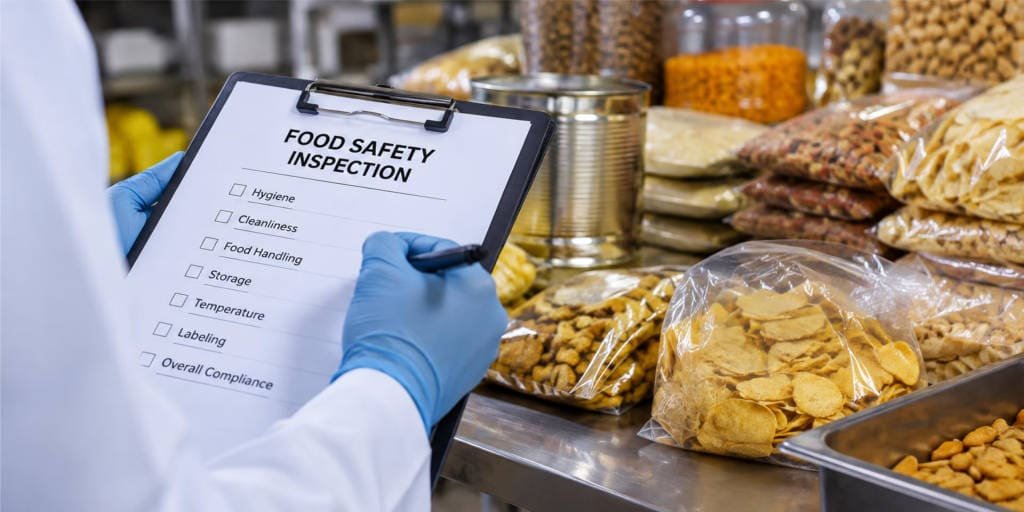
What FSSAI Inspectors Look For
During inspections, food safety officers verify key aspects of compliance, including a valid FSSAI registration or licence displayed at the premises, hygiene and sanitary practices, GMP compliance, pest control and waste disposal, implementation of food safety management systems, proper storage and FIFO/FEFO stock rotation, accurate labelling, and records such as production, raw material and testing records.
For a practical guide to the hazard analysis process, see the step-by-step hazard analysis guide. Third-party audits can also provide evidence of compliance; see the importance of third-party audits in food safety certifications.
Risk-Based Inspections: The New Framework
FSSAI has integrated a risk-based inspection and food safety audit framework. Inspection frequency is influenced by compliance history, surveillance records, self-compliance testing results and third-party audit outcomes.
Businesses with a strong compliance record may face fewer inspections, while non-compliant and repeat offenders may receive more targeted and frequent visits. Maintaining accurate records, filing returns on time and addressing audit findings can reduce regulatory risk.
Food Safety Index
The State Food Safety Index ranks states on factors including compliance rates, inspections, sampling, enforcement and capacity building. Kerala has consistently topped the index. See how the Food Safety Index is calculated for further context.
Step 5: Penalties for Non-Compliance
Penalties Under the Food Safety and Standards Act, 2006
- Operating without an FSSAI licence: imprisonment up to 6 months and/or a fine up to ₹5 lakh.
- Selling sub-standard food: fine up to ₹5 lakh.
- Selling misbranded food: fine up to ₹3 lakh.
- Selling unsafe food where no injury occurs: imprisonment up to 6 months and/or a fine up to ₹1 lakh.
- Unsafe food causing grievous injury: imprisonment up to 6 years and/or a fine up to ₹5 lakh.
- Unsafe food resulting in death: imprisonment from 7 years to life and a fine of not less than ₹10 lakh.
- Failure to comply with an officer’s directions: fine up to ₹2 lakh.
- Failure to display the FSSAI licence number: penalty as prescribed.
Source: Food Safety and Standards Act, 2006.
These penalties apply per incident. An inspection identifying multiple violations can therefore result in cumulative fines exceeding ₹10 lakh, alongside criminal proceedings.
Recent Enforcement Actions – 2026
Andhra Pradesh: ₹5.65 lakh in fines imposed on 16 establishments for operating without valid licences, selling expired food and maintaining unhygienic premises.
Nationwide: 4,461 licences suspended and 11,493 cancelled over the last five years.
Parliament data: 40,023 food samples found non-conforming in FY26; 31,878 civil cases decided with penalty; and 1,918 criminal convictions.
For a broader view of recent enforcement trends, see major food safety failures in India.
What “FSSAI Approved” Actually Means
“FSSAI Approved” should not be presented as a quality endorsement. It indicates that the business is registered under the regulatory system and is legally responsible for its products. FSSAI prohibits the use of its logo in promotional claims that suggest regulatory endorsement.
Conclusion
FSSAI compliance in 2026 is evolving, with relief for smaller businesses through higher turnover thresholds and perpetual validity, alongside stronger enforcement through risk-based inspections and penalties for violations.
The businesses best prepared for this environment will treat compliance as an ongoing management system rather than a formality. Maintain accurate records, file returns on time, substantiate product claims and keep premises inspection-ready. Regulatory changes can occur frequently. Businesses should monitor FSSAI updates regularly and review their compliance systems as requirements change.
Downloadable Resources
- FSSAI Compliance Checklist (PDF) – a checklist for manufacturers, retailers and cloud kitchens covering licensing, labelling, storage and inspection readiness. Download Here
- Label Declaration Template – an editable template covering mandatory fields under the Labelling and Display Regulations, 2020. Download Here
- FoSCoS Application Guide – a step-by-step walkthrough with screenshots for first-time applicants. Download Here
- Penalty Reference Sheet – a quick reference for common violations and corresponding penalties under the Food Safety and Standards Act, 2006. Download Here
- Access these resources by subscribing to PFI’s newsletter. Implementation of revised turnover threshold for food businesses under Food Safety and Standards (Licensing and Registration of Food Businesses) Regulations, 2011. Download Here
FSSAI Food Safety Compliance – FAQs
1. Does a home baker need FSSAI registration?
Yes. A person carrying on a commercial food business, including a home bakery, is an FBO and must obtain the appropriate FSSAI registration or licence based on turnover. Selling through social media does not provide an exemption. See starting a bakery business in India.
2. What is the penalty for operating without an FSSAI licence?
Imprisonment up to 6 months and/or a fine up to ₹5 lakh per incident.
3. How long is an FSSAI licence valid?
Under the 2026 amendment, FSSAI licences and registrations have perpetual validity unless suspended, cancelled or surrendered. Annual fee payment remains mandatory, and State Licence holders must file annual returns.
4. What happens if I miss the annual fee payment?
The penalty is 3× the annual fee for delays of 1–90 days, 5× for 91–180 days, and after 180 days a fresh licence is required. A six-month delay on a Central Licence with a ₹7,500 base fee would mean ₹45,000.
5. What is FoSCoS?
FoSCoS (Food Safety Compliance System) is the digital portal for FSSAI registrations, licences, modifications and annual returns. Applications are filed through FoSCoS. For a walkthrough, see the step-by-step FSSAI registration process guide.
6. Do I need the FSSAI logo on small packs?
Packs under 100 sq cm are exempt from the FSSAI logo requirement under the packaging regulations.
7. What are front-of-pack warning labels?
These are red hexagonal warnings being developed for foods high in added sugar, salt or saturated fat. FSSAI has proposed phased implementation but has told the Supreme Court that it is open to stricter, immediate labelling. See the Supreme Court FOPL order for the legal context.
8. Can I use the same FSSAI licence for multiple outlets?
No. Each premise requires its own FSSAI registration or licence. One licence covers the food activities carried out at that premise.
9. What documents are needed for an FSSAI licence?
Typical documents include identity proof, premises proof, layout plan, equipment list, water test report and NOC where applicable. Requirements vary by licence category. See FAQs on FSSAI Registration and FSSAI License.
10. What is the new turnover threshold for State Licence?
From 1 April 2026, State Licence applies to businesses with annual turnover between ₹1.5 crore and ₹50 crore.