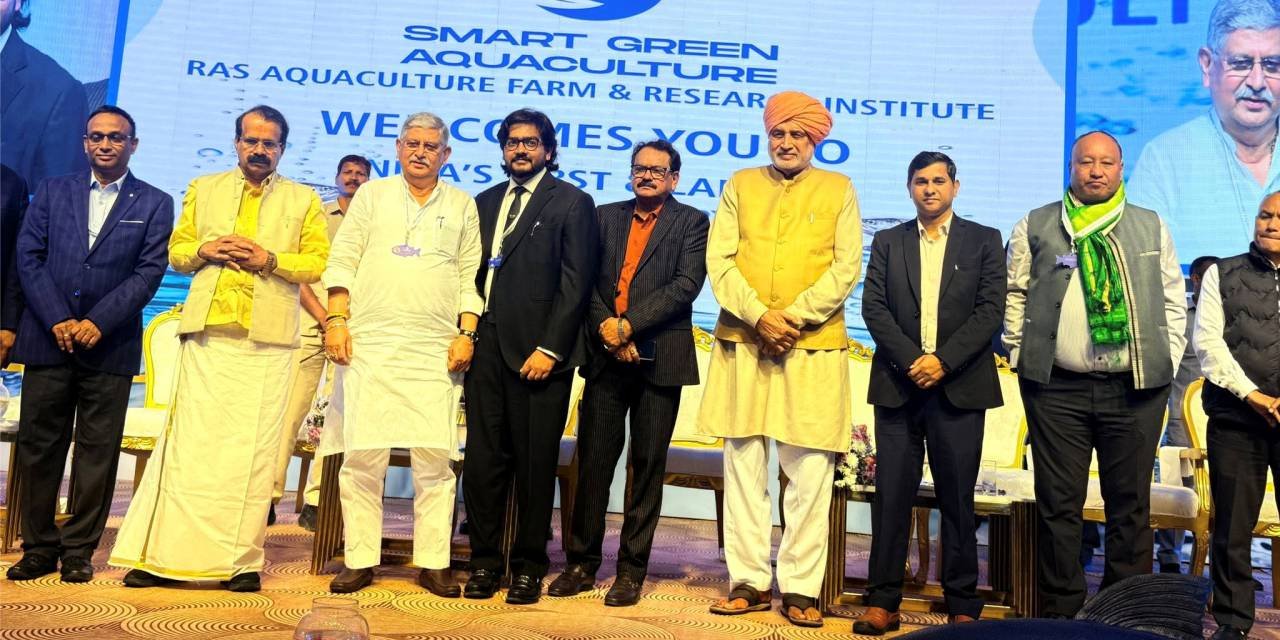
SmartGreen Aquaculture inaugurated India’s first inland, state-of-the-art premium trout farming facility, marking a major milestone for the country’s aquaculture sector.
January 20206: SmartGreen Aquaculture (SGA) has inaugurated India’s first inland, RAS-based premium trout farming facility in Telangana, demonstrating the viability of cold-water aquaculture in warm regions and outlining plans for phased expansion and a microalgae biorefinery.
The facility challenges conventional geographical limitations by demonstrating that cold-water aquaculture can be successfully operated in warmer regions such as the Deccan Plateau. Alongside the farm, SGA has announced plans to establish a flexi-scale premium microalgae biorefinery and a dedicated skill development centre for Recirculating Aquaculture System (RAS) technology on the same campus.
Developed at an initial investment of approximately USD 6 million, the facility has a planned total production capacity of 1,200 metric tonnes. It is entirely based on sustainable RAS technology, enabling year-round trout production within a controlled, biosecure indoor environment.
The integrated facility comprises dedicated hatchery units, indoor grow-out systems operating under RAS, on-site processing and cold-chain infrastructure, and a proprietary online platform that delivers fresh and value-added trout products directly to consumers.
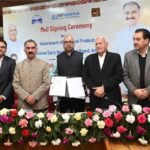
The first phase of the aquaculture farm and associated research institute was inaugurated by Union Minister of Fisheries, Animal Husbandry and Dairying and Panchayati Raj Rajiv Ranjan Singh (Lalan Singh), Union Minister of Coal and Mines G Kishan Reddy, and George Kurian, Minister of State for Fisheries, Animal Husbandry and Dairying and Minority Affairs.
Addressing the gathering, Rajiv Ranjan Singh said Smart Green Aquaculture exemplifies the innovation emerging from India’s startup ecosystem. He noted that farming cold-water species such as trout in a climate like Hyderabad’s underscores the role of advanced technology in shaping the future of Indian industry.
Aditya Rithvik Narra, Founder and Managing Director of Smart Green Aquaculture, said the company aims to contribute to India’s Blue Revolution by building a reliable, sustainable, and scalable model for high-value aquaculture species, supported by strong quality controls, traceability systems, and a world-class microalgae biorefinery.
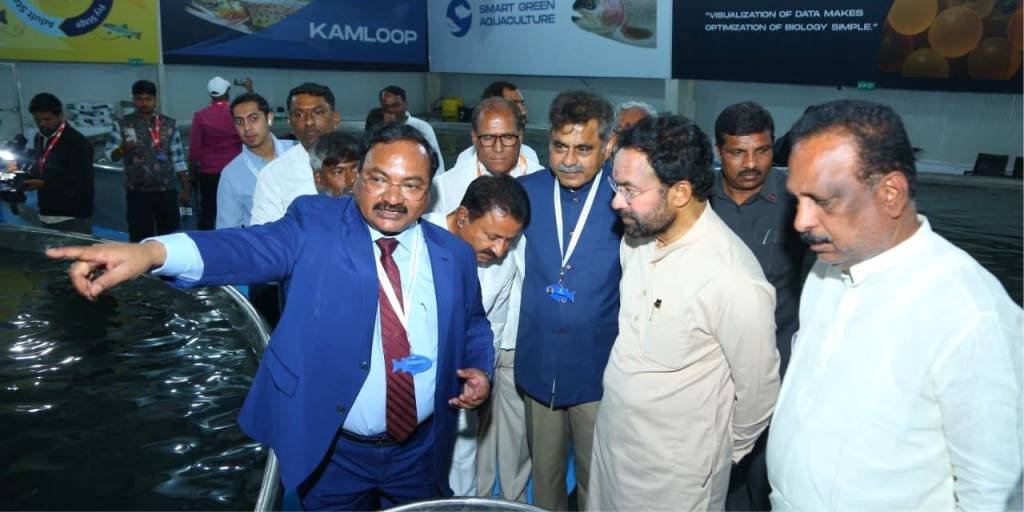
Fully Integrated Farm-to-Consumer Model
The SGA hatchery spans five acres, while the grow-out facility covers two acres and supports approximately 200 direct and indirect jobs. The grow-out farm operates 44 circular tanks, ranging from five to ten metres in diameter and 1.5 metres in depth, at an average stocking density of 70 kilograms per cubic metre. This configuration supports an annual production capacity of 1,200 metric tonnes. The hatchery has the capacity to produce 1.2 million fingerlings annually.
In addition, SGA’s premium microalgae cultivation and processing (PMAC) platform is designed to produce biomass for nutraceuticals, aquafeed, cosmetics, pharmaceuticals, and sustainable agriculture, and is expected to become operational by 2026–27.
By integrating hatcheries, farming, processing, and e-commerce under one roof, the company aims to reduce dependence on imports and intermediaries while ensuring freshness, biosecurity, environmental control, and end-to-end traceability.
Sustainable Inland Aquaculture Using RAS
Unlike conventional open-water systems, the Smart Green facility operates as an inland freshwater farm, continuously recycling and treating water through RAS technology. This significantly lowers water consumption, minimizes environmental impact, and ensures consistent water quality—critical for sensitive species such as rainbow trout.
RAS technology enables precise control over temperature, oxygen levels, and biosecurity, making trout farming viable in warm-climate regions like Telangana.
- Himachal Govt, NDDB Sign Three MoUs, Strengthen Dairy Infrastructure and Farmer Incomes
- AAHAR 2026 Concludes on a High Note with Record Participation
- How to Start Small Scale Ginger Garlic Paste Making Business
- Aahar 2026 Inaugurated by Piyush Goyal, Showcasing India’s Growing Agri-Food Exports
- India-US Trade Deal 2026: Impact on Indian Agri-Food Sector
Phased Expansion and Market Focus
The first phase of the project, with an initial production capacity of 360 metric tonnes, is nearing the ready-to-market stage. Subsequent phases will scale output to the full capacity of 960 metric tonnes per year. SGA will primarily target India’s domestic premium seafood market, serving retail consumers, hospitality players, and institutional buyers through both online and offline channels.
The company also operates processing facilities that convert rainbow trout into value-added formats such as fillets, steaks, skinless, and degutted products, while continuing to develop new offerings. Plans are underway to build indigenous hatchery capabilities and achieve complete self-sufficiency in trout egg production in the next development phase.
Beyond commercial operations, SGA aims to engage local communities, develop technical skills, and provide stable income opportunities. The company has initiated technology transfer programmes to enable small-scale farmers to operate compact aquaculture units under a buy-back arrangement with SGA.
India is currently the world’s second-largest fish producer, supported by policy initiatives such as the PM Matsya Sampada Yojana and the Blue Economy framework. The global aquaculture market is projected to grow from USD 296 billion in 2023 to USD 421 billion by 2030, while the microalgae industry is expected to expand from USD 1.8 billion to USD 3.5 billion over the same period.
(Source: ANI)

Have a news or topic to share with industry? Write to us editorial@pfionline.com