
Good Food Institute India releases a comprehensive study mapping technical skill gaps in India’s smart protein sector, highlighting workforce needs across plant-based, cultivated meat, and fermentation value chains.
Good Food Institute India (GFI India) has released a detailed report analysing of India’s smart protein talent pool. It identifies critical technical skill gaps across plant-based, cultivated meat, and fermentation technology value chains. The study shows that there is a structural mismatch between India’s strong academic output and the specialised, hands-on skills required by a rapidly scaling industry.
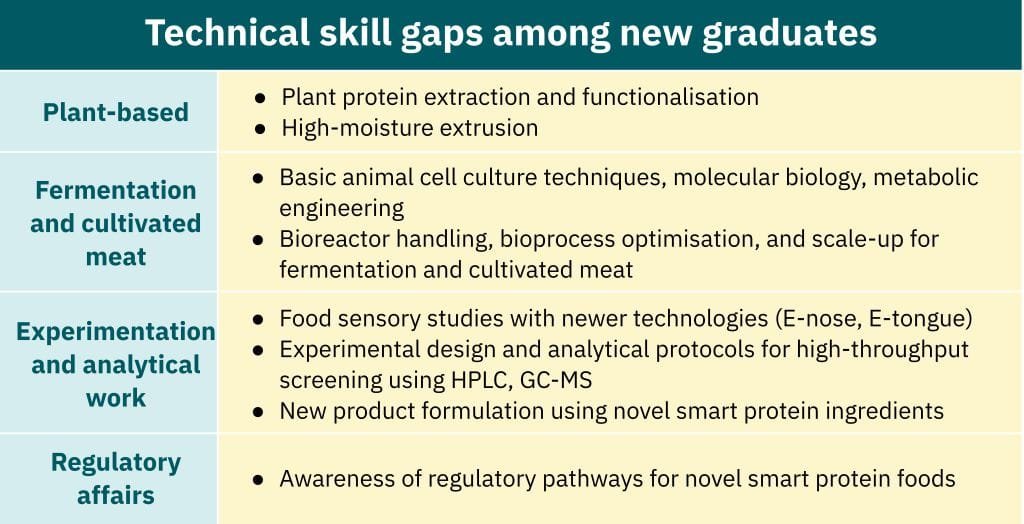
India produces almost 250,000 graduates each year in relevant fields such as food technology, biotechnology, life sciences, and allied engineering streams. Even though there is a significant talent pipeline, employers across the smart protein ecosystem consistently report a shortage of job-ready professionals. The shortage is especially bad in high-growth technical fields like bioprocessing, cell culture, extrusion technologies, advanced analytical methods, and emerging food safety and regulatory pathways tailored to novel proteins.
Conducted with support from Idoboro Impact Solutions, the study maps skill requirements across the entire value chain, from research and product development to scale-up and commercial manufacturing. While India’s academic institutions provide strong theoretical grounding in core sciences, the report finds that limited hands-on laboratory exposure and the absence of smart protein-specific coursework are constraining workforce readiness. As a result, companies face longer onboarding cycles and increased training costs, potentially slowing sectoral growth.
The findings arrive at a pivotal moment. India’s smart protein ecosystem is gaining policy and institutional momentum, supported by frameworks such as the BioE3 policy and an expanding base of startups, research institutions, and incubators. Yet, without targeted interventions in curriculum reform and skilling infrastructure, talent readiness could emerge as a key bottleneck to scaling innovation and manufacturing capacity.
Sneha Singh, Managing Director of GFI India, emphasised that India’s scientific foundation provides a strong starting point, but translating this potential into a future-ready workforce requires coordinated and deliberate action. Curriculum innovation, structured industry-academia collaboration, and experiential training will be essential to equip graduates with applied, sector-specific capabilities.
| Also Read: Rise of Plant-Based Foods: Trends, Challenges, and Opportunities
Strategic Recommendations to Strengthen the Talent Pipeline
The report outlines a set of actionable recommendations for academia, industry, and policymakers.
1. Fast-track curriculum integration under the National Education Policy (NEP) 2020
Leveraging the reform-oriented provisions of the National Education Policy 2020, educational institutions can introduce smart protein-focused electives and value-added modules within existing food technology and biotechnology programmes. A learner-centric approach, incorporating structured feedback from both students and industry, can accelerate curriculum updates. Additionally, government-certified online courses and national certificate programmes hosted on platforms such as SWAYAM could expand access to specialised theoretical training.
2. Deepen industry–academia partnerships for hands-on training
The study highlights strong student preference for experiential learning through internships, workshops, and collaborative projects. Formalised partnerships between universities and smart protein companies can enable certificate programmes, co-supervised capstone projects, and exposure to specialised equipment. As technological sophistication increases, faculty capacity-building will also be necessary. Training-of-trainers initiatives, supported by government grants and sector skill councils such as FICSI and LSSSDC, can build a pipeline of qualified instructors capable of delivering practical, industry-aligned instruction.
3. Establish a national, government-backed training consortium
To institutionalise coordination, the report recommends forming a multi-stakeholder consortium comprising academia, startups, industry leaders, research institutes (including IITs, NIFTEMs, CSIR laboratories, and ICAR institutes), and skilling bodies. This consortium would identify emerging skill gaps, co-design curricula, and create structured feedback loops to update programmes in line with evolving industry needs.
| Also Read: Top Plant-Based Meat Companies in India: A Comprehensive Guide
| Also Read: Labelling Regulations for Plant-based Meats
A hub-and-spoke model is proposed, wherein advanced institutions with established laboratory infrastructure function as Regional Training Hubs. These hubs would support universities, colleges, and vocational centres across states, ensuring national alignment on quality standards and priority skills.
Aligning Talent Development with India’s Smart Protein Ambitions
GFI India’s analysis makes clear that aligning curricula, training frameworks, and industry demand is critical for India to position itself as a global hub for smart protein innovation. Beyond industrial competitiveness, strengthening the workforce pipeline will contribute to national objectives related to food security, sustainability, and economic growth.
By proactively addressing technical skill gaps today, India can convert its substantial educational output into a specialised, future-ready workforce capable of accelerating the smart protein sector’s long-term trajectory.
| Also Read: Plant-Based Meat Products in India: A Growing Trend in the Indian Food Industry
Industry perspectives on critical skill requirements
The All India Survey on Higher Education (AISHE) 2021-22 indicates that 249,879 graduates across UG, PG, and PhD degrees at public and private universities, colleges, and standalone institutions are from smart protein-relevant disciplines. In spite of this, the fi ndings from initial surveys and interviews conducted with active industry stakeholders indicated that most graduates appeared to lack essential smart protein-relevant practical skills. The primary reason for this is that current theoretical and practical training from most UG academic degrees in Food Technology, Agricultural Sciences, Biotechnology, Chemical Engineering, Microbiology (or similar core scientifi c degrees of All India Council for Technical Education (AICTE) and University Grants Commission (UGC)-certifi ed B.Sc./B.E./B. Tech programmes) do not teach such skills.
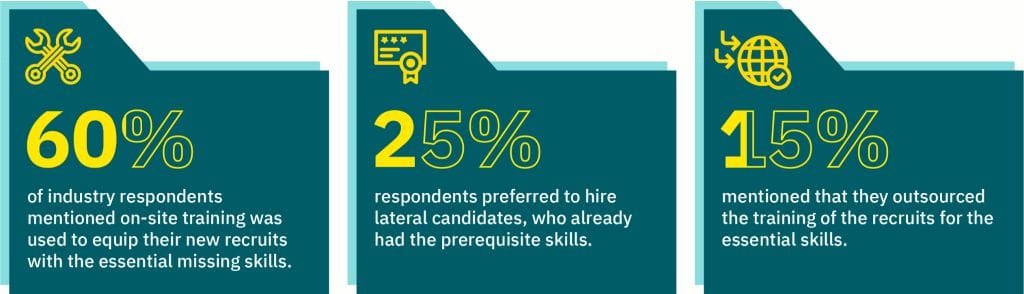
Emerging smart protein technology startups converged on the need for stronger hands-on training in biotechnology skills such as animal cell culture and molecular biology, as well as in operating high-moisture extruders (HME), bioreactors, analytical instruments, 3D food printers, and emerging food sensory analytical instruments such as E-nose and E-tongue.
Aside from scientific skills training, another critical challenge highlighted by industry representatives was the lack of courses for food safety training dedicated to the ‘novel foods’ category, i.e., cultivated meat and fermentation-derived smart proteins. Most existing food safety certificate courses, like the FSSAI’s Food Safety Training & Certification (FoSTaC) programme, focus on general quality control and Hazard Analysis and Critical Control Points techniques for evaluating conventional food value chains from a hazard detection and prevention angle.
Full report can be accessed here.

Have a news or topic to share with industry? Write to us editorial@pfionline.com