Indian buffalo meat exports reached $5.1 billion in 2025-26, driven by rising global demand, modern processing infrastructure and stronger export markets. Behind this growth is a wider economic ecosystem. Explore the export growth, processing industry, global markets and link with dairy farming.
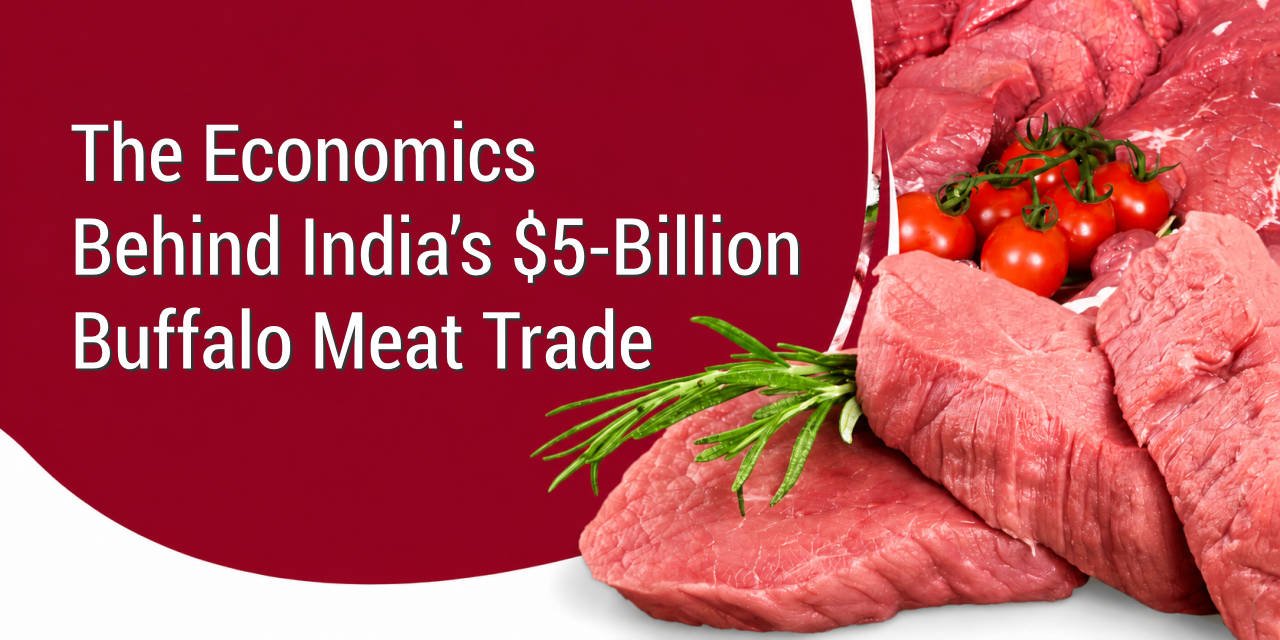
Indian buffalo meat industry has quietly emerged as one of the country’s strongest agricultural export businesses. Buffalo meat exports crossed the $5-billion mark in 2025-26, and the sector is now on course to exceed $6 billion in the current financial year.
The numbers are impressive. But the larger story is not simply about exports. It is about how an industry built around spent buffaloes has become an important part of India’s dairy economy, created a substantial processing and export infrastructure, generated value from meat by-products and established a stronger position in international markets.
Buffalo meat, commonly known as “carabeef” in international markets, now accounts for about 79.4% of India’s animal-product exports, according to the figures provided.
Indian Buffalo Meat Exports Targets $6 Billion
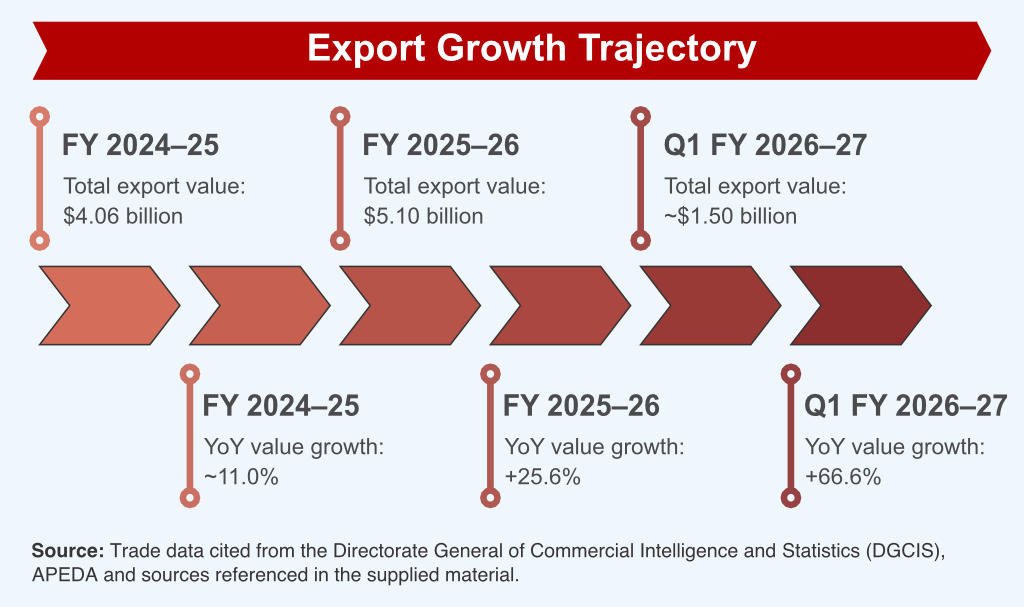
Indian buffalo meat exports rose 25.6% to about $5.1 billion in 2025-26, compared with $4.06 billion a year earlier. The momentum has continued into 2026-27. Exports during April–June 2026 were estimated at nearly $1.5 billion, up 66.6% from $896.8 million in the corresponding period of the previous year.
A Commerce Ministry official said that India is on track to cross $6 billion in Indian buffalo meat exports in 2026-27 if the current pace continues.
Importantly, the growth is not being driven by volume alone. The value realised per tonne has increased significantly. Average export realisation rose from about $3,236 per tonne in 2024-25 to $3,591 in 2025-26. During the April–June 2026 quarter, it reached $4,392 per tonne.
This represents a significant change in the position of Indian buffalo meat in global markets.
In 2014-15, a tonne of Indian buffalo meat was valued at around $3,240. International prices then weakened for several years, falling to between $2,700 and $3,000 per tonne. Today, buyers are paying considerably more. The Q1 2026 realisation of $4,392 per tonne is around 35% higher than the 2014-15 level.
The price gap with Brazilian cattle beef has also narrowed. Indian buffalo meat historically sold at a discount of around $2,000 per tonne compared with Brazilian cattle beef. That gap has now fallen to approximately $500-700 per tonne.
This suggests that Indian carabeef is no longer being viewed simply as a low-cost substitute. Its quality, safety standards and suitability for industrial processing are gaining greater recognition.
Fauzan Alavi, secretary of the All India Buffalo and Sheep Meat Exporters Association, told The Indian Express that exporters have worked in recent years to position Indian buffalo meat as a global brand rather than merely a lower-cost alternative to cattle beef.
From commodity to processed export
This change has been supported by tighter regulation, investment in processing infrastructure and a shift in the way Indian exporters approach international markets.
Meat exports are permitted only from certified facilities. India currently has 83 APEDA-approved integrated abattoir-cum-processing plants, each with a capacity to handle between 500 and 2,000 animals a day, in addition to standalone slaughterhouses and processing units.
The nature of the product being exported is also changing.
Indian exporters once relied heavily on low-margin, 20-30 kg bulk frozen blocks. Processing plants are increasingly producing consumer-ready formats, including retail packs of one kilogram or less, allowing Indian products to reach supermarket shelves directly.
APEDA also collects a levy of Rs 250 per tonne on Indian buffalo meat exports. The proceeds are used through a meat export development fund to support activities such as overseas trade delegations, buyer-seller meets and efforts to address non-tariff barriers.
The industry’s market base is becoming more diversified as well. A decade ago, nearly 45% of India’s buffalo meat exports went to Vietnam. Vietnam remains a major market, but dependence on a single destination has declined.
Egypt, Malaysia, the UAE, Saudi Arabia, Indonesia, Iraq, the Philippines and Jordan are among the markets buying significant quantities of Indian carabeef. Newer destinations, including Uzbekistan, Russia, Georgia, Oman and Senegal, are also gaining importance.
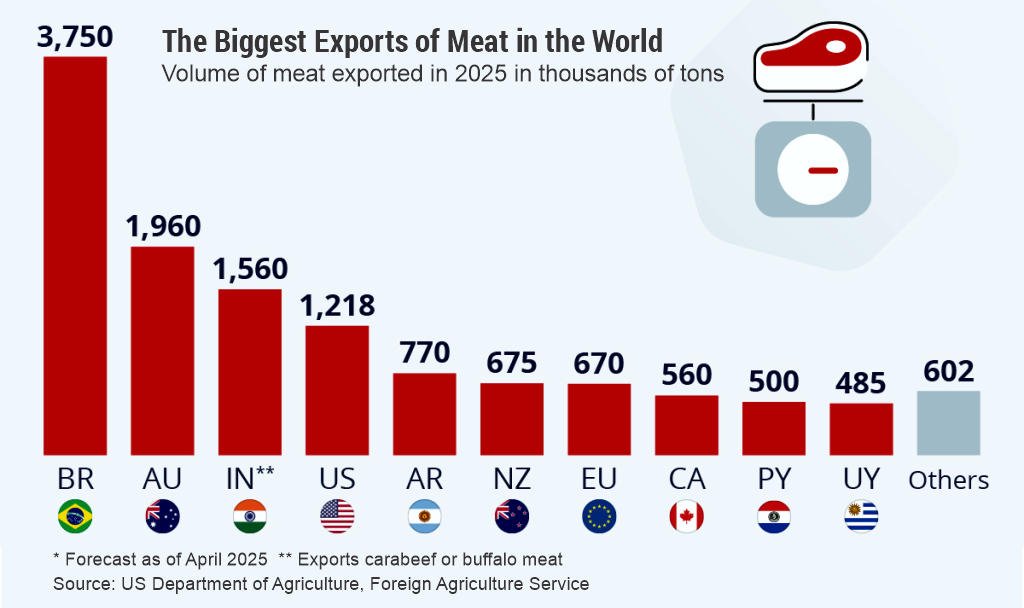
According to USDA data cited in the source, India is now the world’s third-largest bovine meat exporter, behind Brazil and Australia. The opening of markets in CIS countries could provide another avenue for growth.
The dairy connection
The real significance of India’s buffalo meat trade lies not only in export earnings but also in its link with dairy farming.
India does not permit cattle beef exports, so the buffalo meat industry largely depends on animals that have reached the end of their productive lives, including females after several milking cycles, infertile animals and male calves. For small dairy farmers, maintaining unproductive animals adds costs for feed, fodder, water and labour. Selling them provides funds to replace them with productive stock.
A typical 400 kg buffalo yields about 190 kg of carcass. At the current Uttar Pradesh abattoir price of Rs 300-320 per kg, its value at the plant is around Rs 57,000-60,800. After transport and trader margins, the farmer may receive about Rs 50,000. A young, first-time milk-producing buffalo costs around Rs 1.25-1.5 lakh, so the sale of a spent animal can finance roughly one-third of a replacement.
This creates a practical cycle of herd renewal, allowing farmers to replace ageing, low-yielding animals with younger, more productive ones. The source estimates that exporting 1.4-1.5 million tonnes of meat annually involves the culling of around 14-15 million animals from India’s buffalo population of about 110 million.
Thus, the buffalo meat trade is not just an export business. It provides an important economic outlet for spent animals and helps support the capital needs of India’s dairy farmers.
A wider industrial ecosystem
The economic impact extends well beyond the abattoir.
India’s meat-processing industry supports a broad workforce that includes blue-collar workers, food-safety professionals, technicians, logistics specialists and compliance teams. While abattoirs have historically had strong links with the Qureshi community, modern integrated export plants employ workers from a much wider social and regional base, including migrant women in processing operations.
Large export houses have also helped professionalise the sector and connect Indian processing facilities with international markets. Companies such as Alana Sons in Mumbai, Fair Exports of Lulu Group and HMA Agro in Agra are among the industry names cited in the source.
The sector also generates value from materials that would otherwise have little economic worth.
Hides support India’s leather and tanning industries, including processing clusters in Kanpur, Unnao and Ranipet. Bones and offal can be processed into gelatin for pharmaceutical capsule shells and collagen products. Other inedible by-products are converted into poultry feed and organic fertilisers.
The result is a wider value chain in which meat processing supports leather, pharmaceuticals, animal feed, agriculture and logistics.
Most importantly for the dairy sector, the income generated from the sale of spent animals provides farmers with additional capital for herd replacement. In practical terms, the buffalo meat trade acts as an indirect source of capital for dairy farming.
Regulation and policy predictability
As the industry targets $6 billion and beyond, the next challenge may be less about demand and more about maintaining a predictable domestic operating environment.
The source cites the closure of five compliant meat-processing plants in Uttar Pradesh as an example of the difficulties that can arise when administrative action at the local level disrupts licensed operations.
The underlying policy distinction is important. The industry argues that there is a clear difference between the prohibition on cattle slaughter and the regulated processing of buffaloes in licensed facilities.
For exporters, consistency in enforcement is therefore critical. Plants that meet regulatory, sanitary and export requirements need a stable framework in which to operate. Uncertainty at the local level can disrupt supply chains, affect farmers who depend on animal sales and weaken confidence among international buyers.
As Indian buffalo meat exports grow, policy predictability will be as important as market access.
APEDA and the export framework
APEDA, under the Ministry of Commerce and Industry, plays a central role in regulating and promoting Indian meat exports. Its responsibilities cover facility approval, sanitary compliance, quality control, traceability and market development.
Export facilities must meet prescribed infrastructure, sanitation and capacity requirements before receiving approval. Exporters are also required to obtain a Registration-Cum-Membership Certificate (RCMC) from APEDA.
Quality controls cover microbiological parameters, residues and hygiene, with inspections of slaughterhouses, cold-storage facilities and transport systems.
For Halal exports, APEDA monitors compliance under the Indian Conformity Assessment Scheme, with certification bodies accredited through the National Accreditation Board for Certification Bodies.
The Meat.Net system provides digital traceability and monitoring. Export consignments undergo government-approved laboratory testing for parameters including microbiological and heavy-metal residues before the required health certification is issued by state veterinary authorities.
APEDA also works with the Department of Animal Husbandry and Dairying to address sanitary and phytosanitary barriers, develop bilateral veterinary protocols and facilitate inspections by authorities from importing countries. These systems matter because India’s future growth in the global meat market will depend not only on competitive pricing but also on food safety, traceability, cold-chain integrity and reliable compliance.

Have a news or topic to share with industry? Write to us editorial@pfionline.com