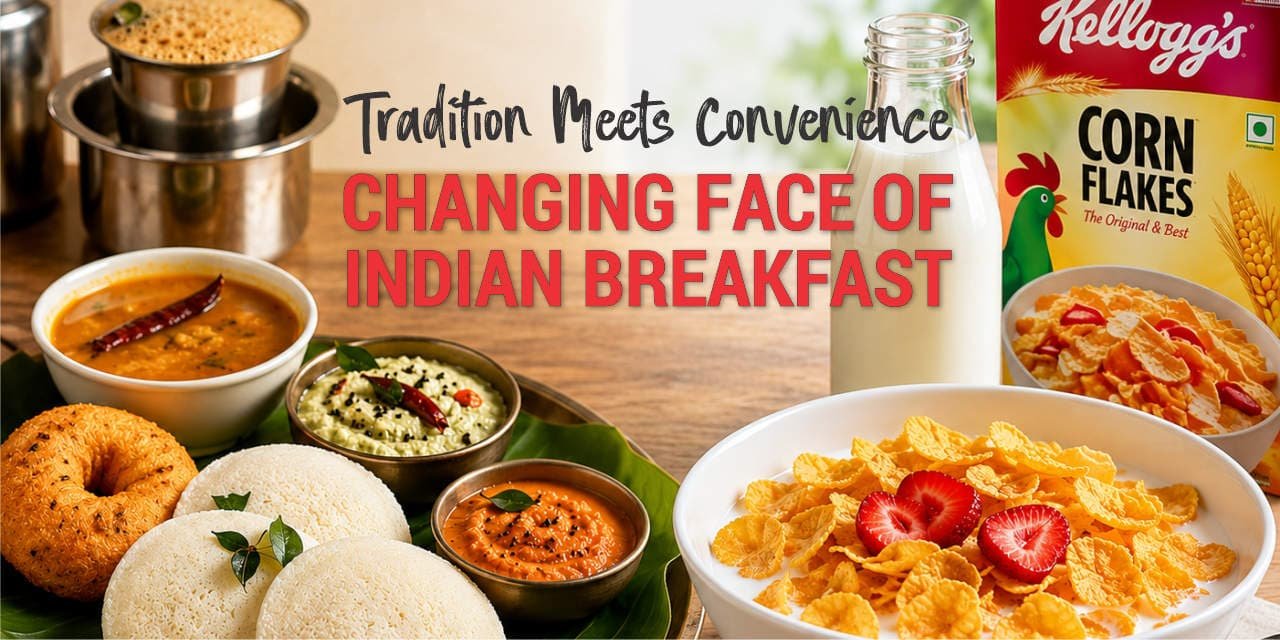
Indian breakfast foods habits are as diverse as its culture, posing both opportunities and challenges for breakfast cereal marketers seeking to build brands. Rajat K Baisya explores India’s diverse breakfast traditions, regional specialties, evolving cereal market, consumer trends, and how brands like Kellogg adapted to Indian tastes.
The breakfast eating habits of Indians are incredibly diverse and traditional. North, East, West, South (NEWS) India’s breakfast dishes are all different. Ingredients used to produce breakfast are also different based on what is grown and available in that region. Breakfasts of all regions are designed to provide nutrition and formulated from wholesome grains or cereals, protein-rich lentils, traditional ingredients and exotic Indian spices as energy boosters to start the day. However, nutritional values vary widely across regions.
If you ask any Indian, they will tell you that breakfast is very important for their health and well-being. They will never skip breakfast. But they don’t have a uniform concept of breakfast. This category is therefore both diverse and traditional as well as modern and westernized.
We can classify these breakfasts region-wise.
South Indian Breakfast
Known for steamed, fermented, and lightly fried dishes, these are typically served with coconut chutney and sambar, which is basically a typical South Indian lentil and vegetable stew made with pigeon peas (toor Dal), tamarind and aromatic spices. It has its own tangy, savory and spice flavour and taste. The typical variety that you get are:
- Idli: Soft, fluffy steamed cakes made from a fermented batter of rice and black lentils.
- Masala Dosa and Sada(Plain) Dosa: A thin, crispy, fermented crepe filled with a spiced potato mash. Sada dosa will not have any filling.
- Medhu Vada: Savory, crispy, deep-fried lentil doughnuts that are fluffy on the inside.
- Ven Pongal: A comforting, savory porridge made of rice and yellow moong lentils, generously tempered with black pepper, cumin, and ghee.
North Indian Breakfast
Heavy on flatbreads and rich, flavorful side dishes.
- Aloo Paratha: Whole wheat flatbread stuffed with a spiced mashed potato filling, cooked until crispy on a tawa (griddle) and often served with white butter or curd (dahi).
- Chole Bhature: A rich and spicy chickpea curry (chole) served with large, fluffy, deep-fried leavened bread. (bhature).
- Puri Bhaji: Deep-fried whole wheat puffed bread (puri) served alongside a tangy and spiced potato curry (bhaji).
- Roti Sabji: Flat bread and spicy potato curry, often also taken with dahi (yoghurt)
Western & Central Indian Breakfast
Fast, straightforward, and highly flavorful.
- Poha: A spiced dish made of flattened rice, tempered with mustard seeds, turmeric, onions, and curry leaves, often garnished with fresh coriander and a squeeze of lemon.
- Upma: A thick, savory porridge made from dry-roasted semolina (sooji) or vermicelli, cooked with vegetables and tempered spices.
- Thepla: Spiced flatbreads from Gujarat, often made with fenugreek leaves (methi) and eaten with curd or pickles.
- Protein-Rich & Instant Items taken also for breakfast and snacks in this region. Great for those looking for quick, high-protein, and gut-friendly morning meals.
- Besan Chilla: Savory pancakes made from chickpea flour, chopped onions, and spices; often called the ‘Indian omelet’.
- Moong Dal Chilla: Nutritious, crispy crepes made from soaked yellow lentils, best paired with mint chutney.
- Paneer Bhurji: Scrambled Indian cottage cheese cooked with onions, tomatoes, and spices, usually served with toasted bread or parathas.
East Indian Breakfast
In East India, the commonly consumed and popular items in breakfast are puffed rice ( Mudi), pressed rice (chida), popped rice (khoi) with milk, or dahi and banana. Mudi, Chida, and Khoi are Eastern India’s popular breakfast cereals produced in a cottage industry using a traditional process for centuries.
Bengalis also take in breakfast what they call Lochi and Sabji, which is equivalent to Puri Bhaji of the North. But Lochi is deep-fried puffed bread made from refined wheat flour. They sometimes, or at least once in a while and more frequently during festivities, will have a special occasion breakfast when Lochi with mutton curry, what they call Kosa Mangsho (marinated chopped mutton) pieces in spicy thick gravy, will be served.
Middle-class Bengali office-goers have no concept of breakfast. They go to the market every day early in the morning to buy their daily fish and vegetables. They will have a freshly cooked meal with dal, seasonal vegetable (sabji) and fish curry in the morning before they go to the office. And that is their breakfast. It is a morning meal that works as a substitute for breakfast.
Younger Generation English Breakfast
Gen-Z living in urban cities will be taking bread, butter toast and omelet or some egg preparations like fried eggs again with variations like both sides fried, poach, water poach and bhurji (scrambled eggs) and some cereals with milk or yoghurt.
YouGov, a global research agency, reveals that eggs are the most popular breakfast choice among Gen Z, with 46% including them in their morning routine. Gen Z gravitates toward quick, health-conscious, and functional morning meals. Instead of traditional sugary cereals, they prefer grab-and-go options like egg-based dishes, smoothies, avocado toast, and oats. They often prioritize high-protein, whole foods.
Their favorite breakfast staples break down into a few distinct categories like:
- Eggs & Savory Bowls: Scrambled or fried eggs are a top choice, often elevated with hot sauce and avocado.
- Smoothies & Bowls: Functional smoothies are massive for Gen Z. They look for blends packed with fruits, nut milks, and add-ins like vegetable protein
- Oats & Dairy: Oats and Greek yogurt or frozen dessert (parfaits) are heavily favored for breakfast. Additionally, cottage cheese has seen a massive renaissance among young consumers as a quick, high-protein base.
- Avocado Toast: The serving as an easy blank canvas for toppings like tomatoes, poached eggs, or red pepper flakes.
Gen Z is also known to eat breakfast much later in the day or skip it entirely. Driven by busy schedules, the concept of ‘all-day breakfast’ is highly popular, leading many to enjoy traditional morning foods – like breakfast burritos (popular Mexican and Tex -Mex dish) – well into the afternoon. Breakfast burritos are eggs and potatoes wrapped in a tortilla. Other ingredients used are bacon, sausage, meat or chorizo with green or red Mexican chilies. This type of breakfast for Gen Z is not made and served at home. These are served in hotels, restaurants and street joints which Gen Z frequents.
Kellogg’s entry into India in 1994 and struggled to establish a new tradition of eating corn flakes with cold milk. The company then adapted its products to local palates and habits, eventually became one of the country’s dominant breakfast brands.
Indian Breakfast Foods Market
Market Size of Breakfast Cereals
- Breakfast Cereals: Valued at roughly Rs 3,000 cr., this is the largest segment.
- Oats: The largest subsegment, worth approximately Rs 800-1,000 crore. Oats, muesli, and millet-based variants are highly sought after as consumers upgrade from basic cornflakes.
- Kids’ Cereals: Another major growth engine, accounting for a Rs 500-600 crore opportunity.
Key Drivers & Trends
- Health and Authenticity: Nearly a third of Indian consumers prefer packaged breakfasts that offer traditional tastes (like poha, upma, or idli) but with modern, low-sugar or millet-based formulations.
- Quick Commerce Boom: SKU counts in the breakfast segment have surged by 50%. Customers increasingly rely on apps for rapid delivery of ready-to-eat (RTE) meals, fresh batters, and staple milk products.
India’s packaged breakfast market is worth approximately $3.8 billion (Rs. 34,200 crores) and is projected to reach $8.4 billion (Rs. 75,600 crores). Driven by urban professionals and the rise of quick-commerce platforms like Blinkit and Zepto, the market is expanding rapidly as consumers seek healthier, convenient, and protein-rich meals. Yet another estimate puts the breakfast foods market size at USD 15.7 billion in 2025. IMARC Group expects the market to reach USD 21.0 billion by 2034, exhibiting a growth rate (CAGR) of 3.16% during 2026-2034.
In such complexity, traditional and diverse breakfast eating habits in India, breakfast cereal marketers have been trying to build a brand and business over the years. In this category, we will briefly discuss corn flakes, which is now dominated by Kellogg although we have had local players like:
Mohan Meakin Ltd:
Mohan Meakin Limited is the first Indian company to produce and introduce corn flakes. In fact, they pioneered the corn flakes market in India when they introduced them back in 1963. Their popular brand is Champion. Their flagship cereal is widely known as Mohun’s New Life Corn Flakes (often called Mohun’s Classic or Champion). Product lines include the standard Mohun’s New Life Classic Corn Flakes as well as the chocolate-flavored Mohun’s New Life Choco Flakes. However, they are the first mover but are not doing well. Before the arrival of Kellogg in India, Champion was the only brand available in this category.
United Cereal Products Pvt Ltd:
United Cereal products was the first company to introduce Corn Flakes in their modern imported plant from the UK, having a capacity of 900 MT per annum in Calcutta under the brand name Bingo. This company was owned by Shantanu Chaudhuri, former Director on the board of Shaw Wallace, and nephew of Sachin Chaudhuri, former Finance Minister of India, when Morarji Desai was the PM. This family also owned the Calcutta Flour Mill.
Bingo was launched with a big bang in 1968 and continued its journey till 1971. The product was first launched in Calcutta. My friends Manoj Sharma and Pradip Roy, both migrated to the US in later years, were managing the shift production, and our teacher Prof Sunit Mukherjee was heading the technical function.
While Champion of Mohan Meakin is still surviving but Bingo could not. It is a classic case of marketing failure. The market was not ready for Corn Flakes at that time. If however, they continued the business in spite of making losses, there was a distinct possibility for Bingo to emerge as market leader in the category in later years.
The company suffered from a lack of resources, a lack of strategic direction and dependence on only one product without extending to other related products. Otherwise, UCPL could have been a dominant player in the Indian food industry now.
Kellogg’s Entry into Indian Market
Kellogg’s entry into India in 1994 is a classic business lesson for us. Kellogg was struggling with high prices to establish a new tradition of eating corn flakes with cold milk. That attempt miserably failed, the company then adapted its products to local palates and habits, eventually growing into one of the country’s dominant breakfast brands.
When Kellogg’s entered the rapidly liberalizing Indian market, it heavily invested in local infrastructure, opening their first manufacturing plant in Mumbai. However, their initial marketing and product strategy faced severe hurdles.
- Cultural Clash: Kellogg’s marketed their products to be eaten cold with milk. Conversely, Indian consumers were accustomed to freshly prepared, piping-hot traditional breakfasts like parathas in the North and dosas in the South.
- Sogginess: When consumers tried mixing the crispy flakes with their preferred hot milk, the cereal turned soggy, yielding an unacceptable taste and texture.
- Premium Pricing: Kellogg’s priced their products at a premium that was out of reach for a large portion of the middle class, and struggled to gain repeat customers, as many only bought the product out of novelty.
- Traditional breakfast Eating Habits: Kellogg’s corn flakes was in conflict with the traditional breakfast that mothers used to make for the family.
Kellogg faced difficulties in getting accepted in the Indian breakfast food market with one product and was incurring big losses for over a decade. In fact, in the Kellogg’s history, in all markets, that they took long years in all countries to finally emerge successful. India was thus not an exception.
To survive, Kellogg’s made a strategic shift to adapt to the Indian market:
- Reaching the Kids: Instead of forcing the family breakfast concept, they targeted children by introducing sweeter, more fun-to-eat brands like Chocos and Frosties.
- Price Localization: To address the price sensitivity, they launched affordable, smaller packaging (like 10 sachets) to lower the price barrier to induce trial.
- Fortification & Health: They recognized that Indian consumers highly valued daily nutrition, so they introduced fortified cereals (such as Iron Shakti cornflakes) that tackled common nutritional deficiencies like iron deficiency.
Today, Kellogg India offers products well-suited to the Indian palate. Apart from sweet cereals, they have expanded into categories like oats and even traditional hot breakfast options like upma and poha. By listening to local consumer behaviors and preferences, they transformed their initial business model to fit into Indian traditions of breakfast eating habits. That created a big success story in later years.
Kellogg India (now operating under the global snack and cereal company Kellanova) is now profitable.
Kellogg India’s Recent financial performance in the Indian market includes:
- Revenue: Reached 1,723 crore.
- Net Profit: Jumped by 33% to 129 crore.
- Market Share: Captured around 30% of the Indian breakfast cereal market.
Kellogg was launched in India in 1994, but till 2000, Kellogg was losing money trying to sell western-style breakfast cereal options. And four years later, in 2024, they introduced Upma and Poha – the traditional Indian breakfast.
Kellogg India Private Limited is now owned by Mars Inc, following Mars’ landmark acquisition of global snacking giant Kellanova (formerly the international portion of the Kellogg Company).
The ownership structure follows a series of corporate shifts:
The Split: In 2023, the Kellogg Company split into two independent entities. The North American cereal business remained with WK Kellogg Co, while the international cereal and global snacking business became Kellanova.
The Acquisition: In December 2025, Mars Inc successfully closed its acquisition of Kellanova, absorbing all of its international cereal and snacking operations (including the India business) under the Mars Snacking division. Consequently, all products – including Kellogg’s Corn Flakes, Muesli, and Pringles (originally a P&G product) – came under the Mars Snacking portfolio in India.
Major Players in Indian Breakfast Foods Market
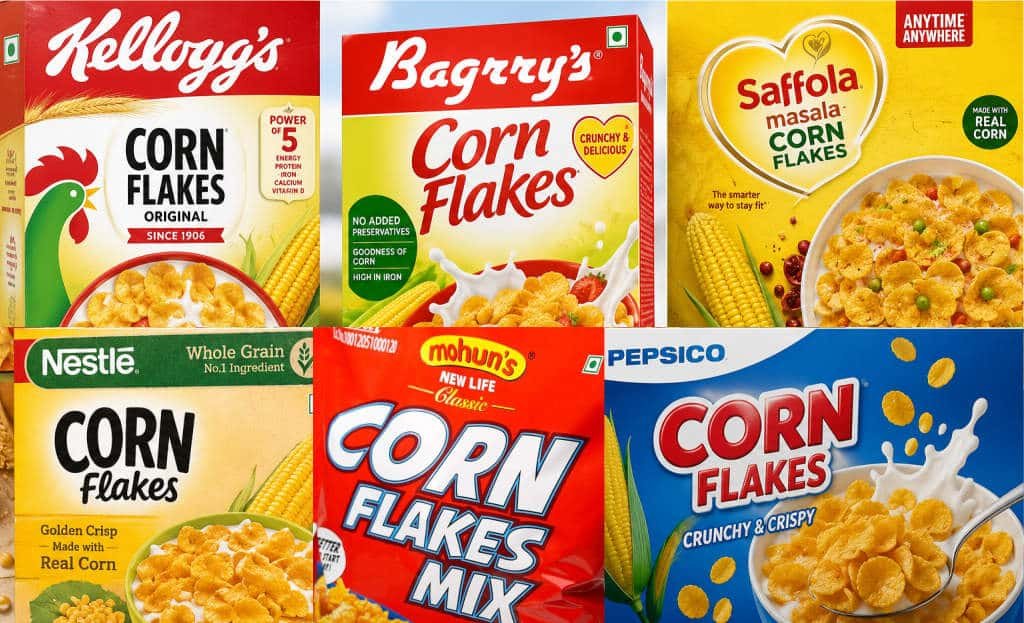
The market remains highly competitive, with established FMCG giants: Kellogg’s, Bagrry’s, Marico Ltd. (Saffola), Nestlé and PepsiCo.
Industry leaders are constantly adapting to changing consumer preferences and offering region-specific options to capture this growing market.
Local companies like GITS, MTR, Haldiram, Marico, etc., are dominating the traditional breakfast food market, although it is still made at home and also in the cottage industry, in spite of the fact that the size of the market is quite large.
However, the breakfast cereal market is dominated by Kellogg, which was acquired by Mars Inc. Kellogg struggled for over two decades to create a success story when our United Cereal Products could not even sustain for three years. Here again, MNC has taken the lead and dominated the category.
💡 Changing Face of Indian Breakfast Foods: FAQs
Breakfast replenishes the body’s energy after an overnight fast, supports cognitive function, improves concentration, and helps maintain steady blood sugar levels. A balanced breakfast also contributes to better overall nutrition and sustained energy throughout the day.
Traditional Indian breakfasts such as idli, dosa, poha, upma, chilla, and paratha can be highly nutritious when prepared with balanced ingredients. Packaged cereals can also be part of a healthy diet, especially if they are high in whole grains, fibre, and protein while being low in added sugar and sodium. The healthier choice depends on the product formulation and portion size.
Indian consumers traditionally preferred freshly cooked, hot breakfasts. Corn flakes were marketed to be eaten with cold milk, which did not align with local eating habits. Premium pricing and unfamiliar consumption patterns further limited early acceptance.
The company adapted its strategy by introducing products suited to Indian tastes, launching smaller and more affordable packs, targeting children with sweeter cereals, fortifying products with essential nutrients, and expanding into familiar breakfast options such as oats, poha, and upma.
Check the nutrition label for:1. Whole grains as the primary ingredient 2. High dietary fibre 3. Adequate protein 4. Low added sugar 5. Moderate sodium 6. Essential vitamin and mineral fortification Also pay attention to serving size and ingredient quality.
Higher-protein breakfasts help improve satiety, support muscle health, reduce mid-morning hunger, and help maintain stable energy levels. This is one reason why foods such as eggs, Greek yogurt, oats, and lentil-based preparations are gaining popularity, particularly among younger consumers.
Yes. Rising urbanisation, busier lifestyles, increasing health awareness, and the rapid expansion of quick-commerce platforms are driving strong growth in India’s breakfast foods market, creating opportunities for both traditional and packaged food manufacturers.
Absolutely. Ready-to-cook and ready-to-eat versions of traditional dishes such as idli, dosa, poha, upma, pongal, and chilla are witnessing growing demand. Consumers increasingly seek convenience without compromising on authentic taste, creating significant opportunities for innovation in processing, packaging, and shelf-life extension.
Key trends include higher demand for convenient foods, protein-rich products, clean-label formulations, fortified cereals, traditional Indian breakfast mixes, millet-based products, and region-specific ready-to-eat offerings that combine nutrition with convenience.
Yes. Rather than replacing traditional breakfasts, packaged foods are increasingly complementing them. Manufacturers are developing products inspired by regional recipes, allowing consumers to enjoy familiar flavours in more convenient formats while preserving India’s rich breakfast traditions.
Dr Rajat Baisya is the Chairman of Strategic Consulting Group and a former Professor and Head of the Department of Management Studies at IIT Delhi. His research and consulting expertise spans marketing, strategy, project management, and international business, and he is recognized internationally for his work in these areas. He also serves as the President of the Project & Technology Management Foundation and can be reached at rkbaisya@ hotmail.com.

Have a news or topic to share with industry? Write to us editorial@pfionline.com