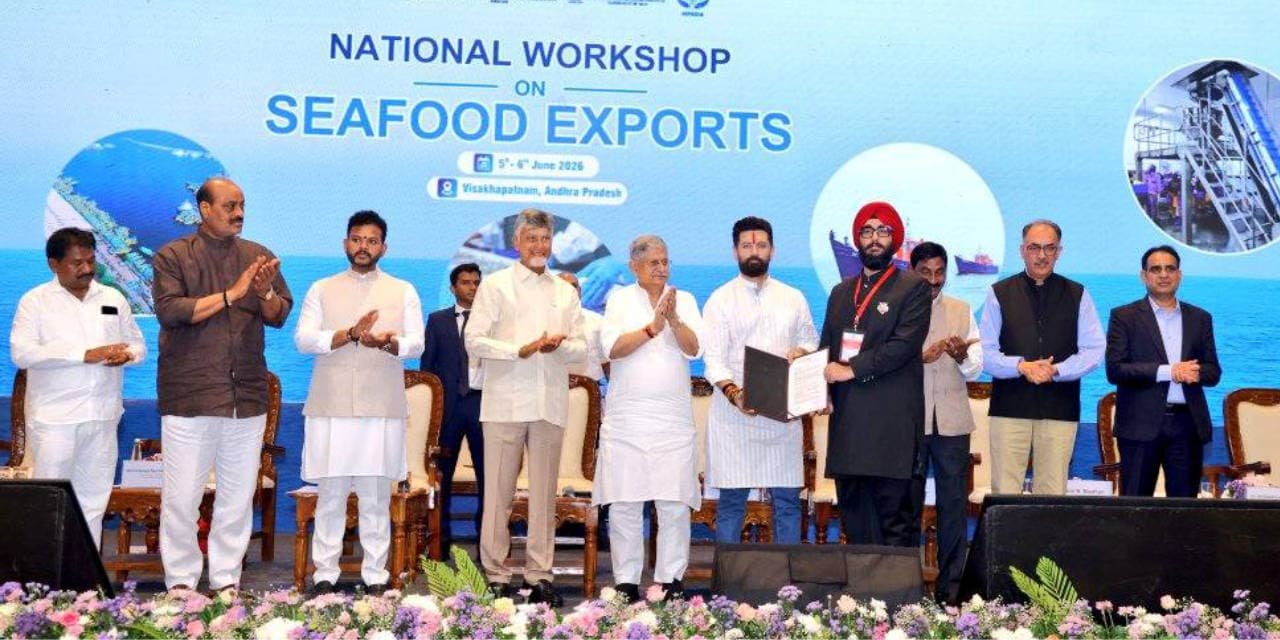
A national seafood export workshop in Visakhapatnam brought together policymakers, industry leaders and exporters to formulate strategies for achieving India’s ₹1 lakh crore seafood export target through value addition, traceability and infrastructure development.
India took a significant step towards its ambitious goal of achieving ₹1 lakh crore in annual seafood exports as a two-day national workshop on seafood exports opened in Visakhapatnam on June 5. The event was convened against the backdrop of the country’s record seafood export performance of ₹73,890.46 crore (USD 8.45 billion) and export volumes of 19.72 lakh metric tonnes in 2025-26.
The workshop was inaugurated by Andhra Pradesh Chief Minister N. Chandrababu Naidu, alongside Union Commerce and Industry Minister Piyush Goyal, Fisheries, Animal Husbandry and Dairying Minister Rajiv Ranjan Singh, Civil Aviation Minister Kinjarapu Rammohan Naidu and Food Processing Industries Minister Chirag Paswan.
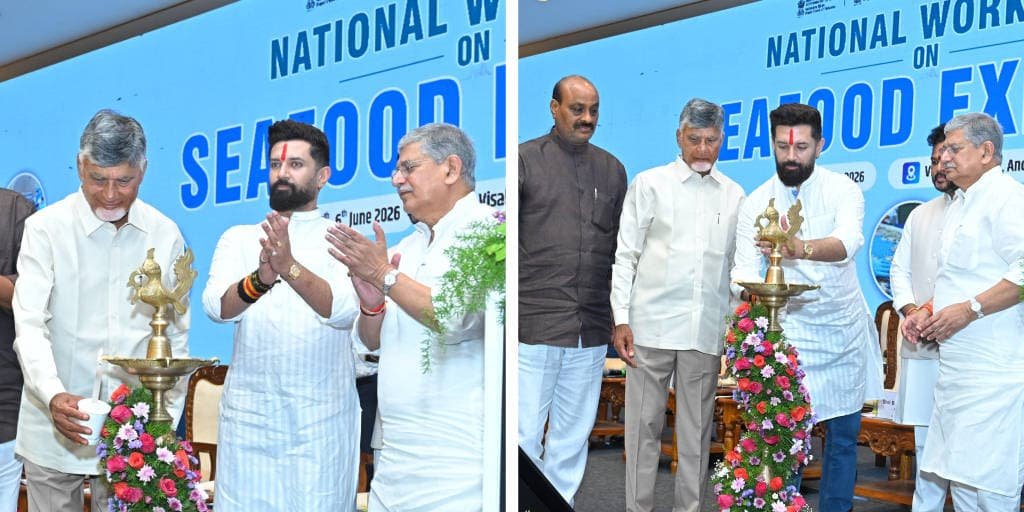
Organised by the Department of Fisheries under the Ministry of Fisheries, Animal Husbandry and Dairying in collaboration with the Ministry of Commerce and Industry, the workshop sought to develop a strategic roadmap for strengthening India’s seafood export ecosystem. Discussions centred on value addition, certification, traceability, export diversification and the greater integration of start-ups and MSMEs into global supply chains.
According to a joint statement issued by the Ministries, the event aimed to address regulatory and infrastructure bottlenecks while improving export readiness across the sector. Technical deliberations were designed to strengthen certification systems, enhance traceability and explore opportunities in emerging sectors that could support export diversification.
The workshop brought together representatives from major institutions, including the Marine Products Export Development Authority (MPEDA), Export Inspection Council (EIC), Food Safety and Standards Authority of India (FSSAI), Bureau of Indian Standards (BIS), and the National Fisheries Development Board (NFDB), along with seafood exporters, processors, industry associations, financial institutions and start-ups. The broad participation was intended to facilitate direct stakeholder engagement and policy alignment.
India’s seafood export sector had demonstrated resilience despite tariff and non-tariff barriers in several key international markets. Government initiatives such as the Pradhan Mantri Matsya Sampada Yojana (PMMSY), the Blue Revolution Scheme, the Pradhan Mantri Matsya Kisan Samridhi Sah-Yojana (PMMKSSY) and the Fisheries and Aquaculture Infrastructure Development Fund (FIDF) had played an important role in strengthening production capacity, improving infrastructure and enhancing export competitiveness. These efforts were further supported by the Ministry of Commerce and Industry’s Export Promotion Mission and the zero-rated GST regime for exports, which helped ensure tax neutrality and reduce cost burdens.
As the host state, Andhra Pradesh showcased its growing significance in India’s seafood economy. The state continued to be the largest fish producer and seafood exporter in the country, achieving an aquaculture production of 5.539 million tonnes during 2025-26. With its extensive coastline, robust aquaculture infrastructure, and established processing facilities, Andhra Pradesh has emerged as a major hub for marine exports.
ALSO READ: India’s Fish Production Doubles in a Decade, Strengthening Global Position
ALSO READ: Parliamentary Panel Reviews US Tariff Impact on India’s Fisheries Exports
Under PMMSY, Andhra Pradesh had received project approvals worth ₹2,324.17 crore. Major investments included six Integrated Fish Landing Centres across Visakhapatnam, Vizianagaram, Kakinada, Tirupati and Anakapalli, three fishing harbours at Pudimadaka, Budagatlapalem and Kothapatnam, and an Integrated Aqua Park at Bapatla. Together, these projects represented investments exceeding ₹1,350 crore aimed at modernising fisheries infrastructure. Additionally, nine projects worth ₹259.28 crore had been approved under FIDF, while more than four lakh beneficiaries in the state had received livelihood support through PMMSY.
The workshop agenda included stakeholder consultations, presentations by key ministries and departments, and the distribution of benefits under PMMKSSY, Kisan Credit Cards and related schemes. Technical sessions were scheduled to focus on value-added seafood exports, certification, traceability, and the role of start-ups and MSMEs in driving export growth and diversification. Participants were expected to formulate recommendations that would strengthen India’s competitiveness in global seafood markets. The workshop marked a significant step in the country’s efforts to build a more inclusive, resilient and future-ready seafood export ecosystem, all while striving towards the ₹1 lakh crore export target.

Have a news or topic to share with industry? Write to us editorial@pfionline.com