

High-value horticulture in India: growth trends, export potential, farmer income opportunities, and Vision 2030 strategy for Atmanirbhar Bharat.
Horticulture has emerged as a central pillar of India’s agricultural transformation, reflecting a structural shift toward market-aligned, income-accretive crops that respond to evolving consumption patterns. The sector now contributes nearly one-third of agricultural Gross Value Added (GVA) and has surpassed foodgrains in aggregate output, underscoring its expanding role in enhancing farm incomes and strengthening linkages with processing, logistics, and organized markets. This transition – driven by diversification, resilience, and sustained value-chain investments – positions horticulture as a key driver of India’s next phase of agricultural growth.
Over the past decade, India’s horticulture output has grown significantly, rising from approximately 281 million tonnes in 2013-14 to an estimated 368 million tonnes in 2024-25. This expansion has been supported by robust domestic demand, increased processing capacity, and strong global demand for safe, traceable, and value-added produce. The sector now anchors not only farmer incomes but also dietary diversification and agri-export potential.
Recent policy and budgetary priorities further reinforce this momentum by focusing on high-value crops such as coconut, cocoa, cashew, and other plantation and specialty segments. Concurrently, the growing adoption of advanced technologies – including AI-enabled advisory systems, precision agriculture, and digital traceability – signals a transition toward a more efficient, transparent, and modern horticulture ecosystem. These interventions are critical to addressing persistent challenges such as ageing orchards, climate variability, quality inconsistencies, and import dependence, while unlocking new income streams for farmers and rural enterprises.

Despite its structural strengths, the sector continues to face systemic constraints. Limited availability of high-quality planting material, declining productivity in ageing orchards, fragmented post-harvest infrastructure, and inconsistent quality and traceability standards restrict competitiveness. These gaps contribute to a structural paradox wherein India remains import-dependent in several high-value segments, even as domestic processing capacity remains underutilized.
In this context, the FICCI-Grant Thornton report, “Focusing on High-Value Horticulture for Atmanirbhar Bharat: Vision 2030,” provides timely, data-driven insights to guide policy, investment, and industry action. It serves as a strategic framework for advancing technology-enabled, market-linked approaches that strengthen ecosystem development and enhance India’s credibility as a reliable global supplier of high-quality horticultural produce.
Effective implementation will require coordinated, mission-driven collaboration among central and state governments, research institutions, industry stakeholders, and producer organizations. Clear delineation of roles, accountability mechanisms, and sustained alignment will be essential to translate strategic intent into measurable outcomes across value chains.
With disciplined execution, India can unlock a high-value horticulture ecosystem that delivers enhanced farmer incomes, greater global competitiveness, efficient domestic value addition, and long-term resilience. This represents not merely incremental progress, but a structural transformation that can position India as a trusted origin for premium horticultural products by 2030.
As emphasized by Chirag Jain, Partner at Grant Thornton Bharat LLP, the transition from food security to nutrition security through horticulture is critical for income enhancement. This shift must be driven by improvements in productivity, quality, and market alignment, supported by investments in quality planting material, private-sector innovation, sustainable cold-chain infrastructure, and strengthened institutional mechanisms such as Farmer Producer Organizations (FPOs), contract farming, and localized production systems.
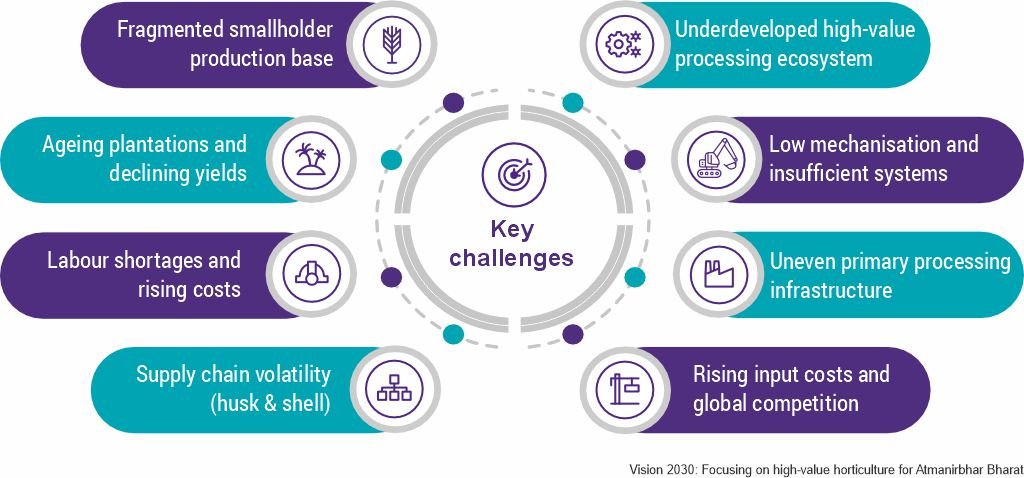
Achieving India’s premium horticulture ambition will depend on aligning policy frameworks, industry investment, and farmer adoption into a cohesive execution model. While the sector benefits from scale, market demand, and policy support, persistent upstream inefficiencies, fragmented value chains, and weak market integration continue to constrain its full potential.
Addressing these structural challenges – ranging from productivity gaps and small landholdings to climate risks, post-harvest losses, and limited access to technology, finance, and markets – will be essential as India advances toward the vision of Atmanirbhar Bharat.
The FICCI-Grant Thornton report, outlines actionable recommendations to scale the sector through enabling policies, private sector participation, technology adoption, infrastructure development, and robust public-private partnerships. It highlights the importance of a mission-led, market-oriented transformation anchored in clean planting material, orchard rejuvenation, localized processing, export readiness, and collaborative partnerships.
Sequenced effectively, these interventions can catalyze sustained private investment, improve asset utilization, reduce import dependence, and establish India as a reliable global supplier of premium horticultural products.
The imperative now is clear: coordinated and disciplined execution. With alignment across government, industry, and producers, high-value horticulture can deliver structurally higher incomes, strengthen export competitiveness, and lay a durable foundation for India’s self-reliance in the coming decade.

Have a news or topic to share with industry? Write to us editorial@pfionline.com