India’s food safety challenges are raising the cost of non-compliance. Rajat K Baisya examines the impact of quality failures on consumer trust, exports and business reputation, and the need for stronger food safety practices across the supply chain.
Since taking charge as Maharashtra’s Food and Drug Administration (FDA) Commissioner on May 25, Tukaram Mundhe has brought food safety challenges into the center stage of discussion and debate in the concerned circles all over the country. His department has already inspected over 3,000 food establishments – restaurants, dairies, cloud kitchens and quick commerce – suspended 165 licenses and issued 764 improvement notices and filed 519 FIRs. Some of the established and reputed brands of processed foods and names of well-known hotels and restaurants have featured in the list.
Table of Contents
Mundhe, an IAS officer coming from a farmer’s family, is said to have been transferred 25 times in 21 years for his uncompromising enforcement of laws in conflict with the forces of power and local mafias. It has been reported that the FDA’s crackdown from May 25 to July 31 inspected 3,130 food establishments and seized 28.6 lakh kg of unsafe food.
Maharashtra’s FDA banned loose oil due to adulteration, unsafe storage, and poor labeling, and seized ₹55.72 Cr in unsafe food. McDonald’s Cuffe Parade, Colaba in Mumbai License has been suspended. He even raided hospitals to find that expired food is being served to patients. The fallout of all these actions taken by Maharashtra FDA is being seen elsewhere in other states as well. Tukaram Mundhe, in that sense, is doing a wonderful job.
Serious Food Safety Challenges in India
The food safety concerns leading to diseases and deaths are a big challenge even in developed countries and we read reports about such outbreaks often. In India, the frequency and magnitude of such occurrences are much higher, which has its own impact on the performance of the industry sector, including economic impacts. On an average, about 100 million cases of food poisoning and about 120000 deaths are reported in India every year. This is quite alarming.
We also have frequent reports of deaths from the consumption of spurious liquors. Large numbers of people die due to consumption of spurious liquor mixed with methanol. The spurious liquor is also arising from uncontrolled fermentation processes being followed by the locals wanting to make quick money, escaping the food safety regulations and standards. The Food Safety and Standards Authority of India (FSSAI) has no control over them.
We also have issues related to food served in religious places and temples on a large scale, which normally escapes the scrutiny of the Food Safety and Standards Authority. In large gatherings during special religious congregations such as Kumbh Mela, food safety issues and concerns are even higher, and it is mostly left to vendors selling fresh and processed, including on-site processed, food products, where no one knows about the quality of the food ingredients used and whether those are permitted.
While FSSAI is performing its role to enforce regulatory standards and practices, food manufacturers must take steps to ensure that their products are safe for consumption and comply with the regulatory requirements. Otherwise, in a vast country like ours, it will be impossible to enforce standards. The problem arises particularly from those small and individual processors who are not even licensed. It is also impossible for FSSAI to bring everyone under their licensing regime, which itself is ineffective.
FSSAI has been mandated as an integrated organization to control food safety, but it does not have enough people and infrastructure to handle this mammoth task. As a result, in spite of the fact that standard practices and quality of processed food have significantly improved over the years, the incidences of failure, diseases and even deaths arising out of food poisoning has not improved. It is increasing and that itself is a big challenge.
A large part of the food safety issues can be traced to the primary inputs in food processing, such as food ingredients and water. In addition, storage and other logistics issues also contribute to product failures. Most of the food-borne diseases reported in India are bacterial, caused by Staphylococcus aureus, Bacillus cereus, Escherichia coli, Salmonella, and Vibrio. Consignments of food exports from India to the US and the EU, especially those of basmati rice, marine food products, spices and fruits and vegetables, on grounds of contamination, continued to be high.
Data from the European Food Safety Authority shows that over 450 food products from India were rejected between May 2024 and May 2026, following an earlier spike of more than 500 flagged products between 2020 and 2024. Spice rejections in Europe surged past 20% for certain categories compared to historical averages of around 5%. There is a wide-spread rejection of spices and marine products from India. There is an economic cost to these rejections and loss of reputation and public image which is difficult to ascertain
Cost of Quality Failure and Non-Conformance
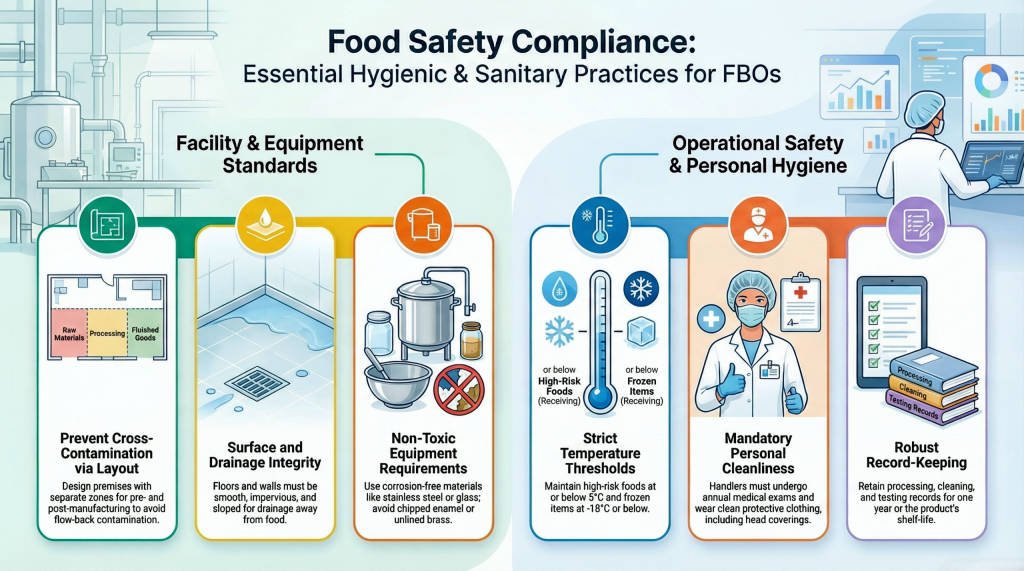
The definition of quality is conformance to the agreed standard of performance and not something superior and better as we normally perceive. If the product delivers agreed and/or contracted standards, then quality is said to have been delivered. The book by Philip Crosby titled “Quality is Free” discusses, with examples, that the cost of non-performance in delivering quality will always be much higher than the cost of producing a quality product and conforming to the standards. In that sense, quality can be considered free. For processed food products, agreed quality standards to be delivered are prescribed by the FSSAI, which need to be adhered to.
Even large organizations, including MNCs, have faced quality failure issues in India and paid a huge price. As such, it makes good sense for all processors to adhere to the prescribed standards and quality at all stages of procurement, processing, storage, and distribution till the product has reached the final consumers for consumption in a safe and hygienic condition.
In case of food products, the cost of quality failure could be tremendous, covering all costs including cost of re-work, reprocessing, loss of business, reputation and image resulting in future loss of business. In addition, there will be penalties, cancellation of licenses and in some cases even jail and legal complications. These costs will be many times more than the cost of delivering quality by adhering to the prescribed standards of processes and practices. These are the immediate implications for the processors and/or manufacturers, traders, distributors, wholesalers, retailers and exporters.
Those who lost their lives from the consumption of spurious and contaminated food products and also from food poisoning which no financial figures can match or make good for losses of valuable human lives. Besides, costs are incurred in hospitalization and resulting associated costs to the nation. In international trade, there are other costs of return and penalty, plus loss of the country’s image and reputation, which have much wider implications and ramifications.
Today’s supply chain is very complex, contributing towards an increased number of microbiological food safety outbreaks. The volume of international food trade has increased over the years. These factors put extra pressure in the system to overlook the standard practices to be followed, sometimes even unintentionally, resulting in a major foodborne outbreak that causes health problems and economic loss. The estimated cost of food safety incidents for the economy of the United States is around $7 billion per year which comes from notifying consumers, removing food from shelves, and paying damages as a result of lawsuits.
Unsafe food causes millions of people falling ill globally, resulting in massive loss in productivity, high medical costs, and severe financial damage to food companies through recalls, lawsuits, and loss of markets. According to estimates by the World Health Organization (WHO), unsafe food costs hundreds of billions of dollars annually in lost productivity and consequential medical expenses.
Impact of Quality Failure on Business
- Loss due to product recalls and destroying the inventory and temporary disruption of production lines.
- Legal costs and penalties arising out of lawsuits, suspension of licenses and registrations.
- Loss of brand image, which takes a long time to regain the trust of consumers that businesses have painstakingly built over the years using resources and through creative marketing efforts.
- Costs of rebuilding the supply chain performance and operating systems to ensure that food safety standards are not compromised.
Impact on the Economy
- Loss of Productivity arising from retraining the workforce, losing experienced and qualified people, resulting in a reduction in economic output.
- Sudden increase in healthcare costs of the nation for treating people who fall ill from consumption of spurious foods and the compensation to be paid for people who lost their lives.
- Loss in global and domestic trade for the reason that countries with poor food safety records will be black listed by importers. International trade practices will block them from lucrative global markets.
- Loss due to decline in tourism because food safety outbreaks and hygiene failures in local eateries can really impact hard the hospitality and tourism sectors.
- Loss incurred in food waste due to poor safety and handling practices across the supply chain.
The cumulative cost of all these issues from non-compliance is huge and sometimes even comes at the cost of losing human lives and other collateral damage. As such, the processed food industry’s contribution to the economy has to be understood from the economics of food safety-related issues.
Food safety is not only a regulatory requirement – it is an economic responsibility. Failures in food safety can damage brands, disrupt trade and erode consumer trust. They can also lead to penalties, cancellation of licences, legal action and, in serious cases, imprisonment.

Have a news or topic to share with industry? Write to us editorial@pfionline.com