Nearly 20% of food samples in India fail safety tests. Rajat K Baisya examines and analyses food safety failures in India, FSSAI enforcement gaps, rising sample failure rates, and urgent reforms under the Food Safety and Standards Act, 2006.
Rising Food Adulteration in India: Alarming Trends and Data Insights
A senior official and past president of AIFPA has recently posted in the WhatsApp group message an order of Food Safety Officer, Anantnag, prohibiting the sales of PriyaGold Butter Delite Biscuit manufactured and marketed by Surya Food & Agro Ltd., Udyog Vihar, Greater Noida in the district of Anantnag for the reason that this biscuit brand in Anantnag has been found to contain sulphite in excess of the permisible limit and therefore unsuitable for human consumption.
The primary source of sulphite in biscuits should be from the deliberate addition of sodium or potassium metasulphite as a dough conditioner to improve the texture of the biscuit. Potassium metabisulphite is also added as a preservative, bleaching agent, and antioxidant. While most sulphites break down during baking process, a small amount can still remain. And it must be declared if the sulphite residue in the biscuit is found to be above 10mg/kg. Priya Gold biscuit was doing well in the north Indian market. Failure to meet food standards is likely to affect their performance.
Baba Ramdev’s Patanjali is often found to come under the lens of law enforcement agencies for various reasons, including product failures, misleading advertisements, misbranding, and exaggerated claims. Numerous cases are filed against Patanjali. Baba Ramdev even apologised and gave a statement to the Supreme Court of India, saying such lapses will not be repeated. Baba Ramdev once flexed his muscles, saying he would force all MNCs to close their shutters by selling comparable or even better-quality products at much lower prices, joining the bogey of Swadeshi and Videshi. But what really happened is that Food MNCs have entered the ayurvedic and natural products categories and are now competing with Patanjali, and all MNC food companies have also maintained their growth rates unabated.
| Also Read: How Food Safety Concerns Impact Business and Economy
| Also Read: 10 Common Hazards in Food Processing Industry
Food Safety and Standards Act 2006: Strong Law, Weak Implementation?
Before 2006, India’s food regulation was fragmented across multiple laws and ministries. To create a unified framework, the Parliament enacted the Food Safety and Standards Act, 2006.
FSSAI is a statutory body, under the 2006 Act, responsible for protecting and promoting public health by regulating the food sector. It operates under the Ministry of Health & Family Welfare.
FSSAI has made significant strides in developing India’s food safety ecosystem, but it continues to face substantial challenges in fully controlling food product quality and non-conformance. While a robust regulatory framework and enforcement mechanisms are in place, actual implementation and compliance remain uneven across the country.
Section 27 of the Food Safety and Standards Act, 2006, outlines the liabilities of food manufacturers, packers, wholesalers, distributors, and sellers for non-compliant food products, holding them accountable for expiry dates, misbranding, unhygienic conditions, and safety violations, ensuring the responsibility of providing safe, wholesome food to be marketed for human consumption. These responsibilities of FSSAI can be grouped into: Setting of Standards; Licensing and Registrations; Monitoring and Enforcement; Accreditation of Food Laboratories across the country; Scientific and Technical Support; and Consumer Awareness and Education.
Before the FSSAI Act of 2006, the Director General of Health Services was heading the implementation of what we used to call ‘Prevention of Food Adulteration Act (PFA)’, and the whole organisation structure was scientific and technical by nature. When FSSAI came into existence, it started functioning like a PSU, headed by a CEO, a Govt appointee, who is generally a bureaucrat. When FSSAI took over, we had 80000 registered cases under PFA, including minor adulteration cases, such as an ant found in a bottle of honey. Most of those cases were subsequently disposed of in accordance with due process within a few years. Against that number, we now have 1.74 lakh cases of food adulteration registered within a span of 5 years.
The question, therefore, naturally arises: why has FSSAI not been able to control rampant food adulteration in India even after two decades of its existence?
Why FSSAI Struggles with Food Safety Enforcement in India
The Public Accounts Committee (PAC) criticized officials from the Ministry of Health and Family Welfare and the Food Safety and Standards Authority of India (FSSAI) about the unchecked sale of adulterated food products.
Even in terms of Food Adulteration in FSSAI’s own admission, nearly 20% of food samples tested in India during 2024-25, including popular chocolate brands, failed to meet required safety standards. The state-wise data for 2024 reveals that Uttar Pradesh alone reported 52.8% of food samples failing safety standards, followed by Rajasthan at 28.4%, Maharashtra at 18.7%, Tamil Nadu at 14%, and Madhya Pradesh at 13%. (Source: FSSAI). Milk, oils, vegetables, sweets, and grains are often found contaminated with harmful substances such as detergents, synthetic dyes, heavy metals, lead chromate in turmeric, and calcium carbide in fruits.
State-level data reveals serious disparities in food safety standards in India:
- Uttar Pradesh – 52.8% failure rate
- Rajasthan – 28.4%
- Maharashtra – 18.7%
- Tamil Nadu – 14%
- Madhya Pradesh – 13%
It is common knowledge that adulterated food can cause immediate symptoms like nausea, diarrhea, allergy, and other health conditions in addition to chronic health diseases like kidney damage, liver dysfunction, and even cancer. But why is it happening?
Manpower shortages are often cited as a limitation for FSSAI in implementing regulatory standards. It is said that insufficient numbers of trained experts and food safety officers are one of the causes for ineffective enforcement. At present, FSSAI has a three-tier registration and licensing regime, classified as Basic, State Level Registration, and Central Registration, based on turnover and coverage. FSSAI has not been able to even bring all FBOs and food manufacturers under the ambit of the licensing regime.
Magnitude of the Task
The Times of India, in its 18th December 2025 issue, reported that one in five food samples tested by regulators over the last five years failed to meet safety standards, exposing the scale of adulteration even as law enforcement has been stepped up. The data, which has been placed before the Rajya Sabha, showed that more than 1.74 lakh food samples were found unsafe and penalties exceeding Rs. 257 crores were imposed on violators across the country, as revealed by FSSAI.
Based on these cases, a few food categories have been placed in the high-risk category, such as milk and milk products, and ready-to-eat foods widely sold and consumed in urban markets. According to this report, nearly 8.7 lakh food samples were analysed nationwide during this period, of which 1.74 lakh samples were found non-conforming to prescribed safety standards and quality norms. In the current FY, about 1.7 lakh samples have been tested, and more than 34000 samples have been found to be failing.
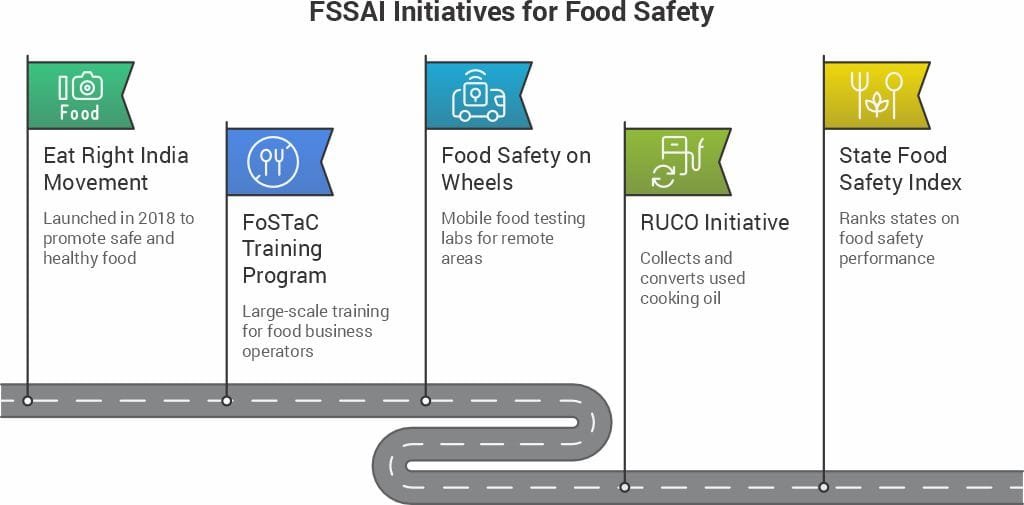
FSSAI Initiatives – Eat Right India, FoSTaC, FoSCoS and Their Ground Impact
To combat food adulteration in India, FSSAI has launched several initiatives:
- Eat Right India Movement (2018)
- FoSTaC (Food Safety Training and Certification)
- Food Safety on Wheels (mobile labs)
- RUCO (Repurpose Used Cooking Oil)
- State Food Safety Index
- FoSCoS digital compliance portal
FSSAI has taken many initiatives to address rising incidences of adulteration and non-compliance. These are – ‘Eat Right India Movement’ launched in 2018, to ensure safe, healthy, and sustainable food for all. It has received international recognition for its comprehensive approach. As of July 2025, 284 Eat Right Stations and 249 Clean Street Food Hubs have been certified, though the numbers remain very low.
Other initiatives include ‘FoSTaC (Food Safety Training and Certification)’, which is a large-scale training program for FBOs. ‘Food Safety on Wheels (FSW)’ ‘Mobile food testing labs’ are instances introduced to enhance outreach, surveillance, and awareness in remote areas. ‘RUCO (Repurpose Used Cooking Oil)’, an initiative to collect and convert used cooking oil (UCO) into biodiesel, preventing its unsafe reentry into the food chain.
‘State Food Safety Index (SFSI)‘, an annual ranking to foster healthy competition among states to improve their food safety performance, which, however, did not result in anything of significance. The other initiatives of FSSAI are ‘Technological Integration’ by launching the FoSCoS (Food Safety Compliance System) portal, an enhanced, single-window platform for licensing, registration, and regulatory compliance. However, the impact of all these initiatives has not yet been translated into reduced incidents of food safety violations at the ground level.
| Also Read: FSSAI to Mandate Scientific Evidence for Food Safety Reviews
| Also Read: Importance of Third-Party Audits in Food Safety Certifications
Strengthening Food Safety Initiatives
The impact of the consumption of adulterated food, which accounts for almost 20% of the total food samples tested, on consumer health, resulting in collateral damage and costs incurred in providing health services and hospitalisation, and the corresponding impact on the country’s economy, which will be much higher.
Regulatory Gaps and Institutional Challenges in FSSAI Enforcement
Persistent food adulteration in India reflects:
- Manpower shortages
- Allegations of licensing irregularities
- Limited transparency in enforcement outcomes
- Inadequate alignment with Codex Alimentarius standards
International rejections of Indian food consignments due to pesticide residues underscore gaps in maintaining globally compliant food safety standards in India.
Economic and Public Health Impact of Food Adulteration in India
Food adulteration in India carries both health and macroeconomic consequences:
- Increased healthcare expenditure
- Productivity losses
- Trade disruptions
- Reputational damage
With nearly one in five samples failing tests, the cumulative economic burden is significant and demands stronger FSSAI enforcement mechanisms.
This issue of Food Safety has attracted attention in the national media. The popular newspaper The Hindu also covered this story in its recent issue. The Hindu even made various suggestions to strengthen food safety measures in India, such as stricter enforcement of the FSSAI Act, 2006, with harsher penalties to deter food adulteration. Establish more accredited food-testing labs nationwide and deploy additional mobile labs (“Food Safety on Wheels”) to remote areas. Hire and train more qualified food safety officers and lab personnel to boost assessment, inspection, and enforcement. Invest in continuous training for food handlers and businesses. Utilize advanced digital tools (AI, IoT, blockchain) for better traceability, real-time monitoring, and efficient compliance.
Streamline online portals like FoSCoS to reduce physical interaction and processing time. Increase public access to FSSAI reports on tested samples, non-compliance, and legal actions. Intensify consumer awareness campaigns to educate citizens on safe food and identify adulteration. Strengthen monitoring and enforce stricter pesticide norms for agricultural and processed foods to tackle the source of contamination. Promote sustainable farming to reduce fertilizer and pesticide overuse. Evaluate and align domestic food safety regulations with international standards like Codex Alimentarius to ensure global compliance and trade facilitation (Source: The Hindu).
Despite a strong legal framework, enforcement of compliance against Food Business Operators (FBOs) is weak. FSSAI requires continuous funding for advanced monitoring and enforcement of technology. Many FBOs, especially small vendors, lack awareness of food safety needs and struggle to comply. Allegations also exist regarding bribes for licensing, selective leniency, and opaque regulatory decisions. Continuous effort is needed to align domestic standards with evolving global norms, as highlighted by the rejection and sometimes even bans on Indian food products due to pesticide residues and non-compliance with microbiological standards.
The Way Forward: Strengthening Food Safety Governance and Compliance Mechanisms
The most important initiatives would be the dissemination of information on the importance of food safety and adherence to legal requirements. As the magnitude of the task is huge, food industry associations like AIFPA should also act as watchdogs, providing surveillance and technical support and educating processors, traders, and exporters on the importance of adhering to food safety standards in their own interests and also in the national interest. It makes good sense for AIFPA and other Food Industry associations to establish a technical support committee to help millions of small, tiny, and home-scale processors comply with safety standards at a nominal cost. That itself will be a great service for the nation and for our people.
💡 Food Safety Failures in India: FAQs
Recent official data indicates that nearly 20% of food samples tested in India fail to meet prescribed FSSAI safety standards, highlighting significant compliance gaps.
States such as Uttar Pradesh, Rajasthan, Maharashtra, Tamil Nadu, and Madhya Pradesh have reported high food sample failure rates, with Uttar Pradesh exceeding 50% in recent assessments.
The Food Safety and Standards Act, 2006 is India’s comprehensive food safety legislation that established FSSAI and consolidated multiple food laws into a single regulatory framework.
Milk is highly perishable and frequently adulterated with water, detergents, synthetic chemicals, or preservatives, making it one of the most vulnerable food categories.
FSSAI has launched initiatives such as Eat Right India, FoSTaC training programs, Food Safety on Wheels mobile labs, RUCO, the State Food Safety Index, and the FoSCoS compliance portal.
Penalties under the Food Safety and Standards Act range from monetary fines to imprisonment, depending on the severity of the violation and the health risk involved.
Food adulteration can cause acute illnesses such as nausea and diarrhea, and long-term effects including liver damage, kidney disorders, and increased cancer risk.
Food Business Operators are legally responsible for ensuring that their products meet safety standards, maintain hygiene practices, and comply with FSSAI licensing requirements.
FSSAI conducts food sampling through designated Food Safety Officers who collect samples for laboratory analysis to determine compliance with prescribed safety standards.
Strengthening food safety governance requires stricter enforcement, expansion of accredited laboratories, increased manpower, digital traceability systems, and greater transparency in reporting violations.
Dr Rajat K Baisya is the Chairman of Strategic Consulting Group and a former Professor and Head of the Department of Management Studies at IIT Delhi. His research and consulting expertise spans marketing, strategy, project management, and international business, and he is recognized internationally for his work in these areas. He also serves as the President of the Project & Technology Management Foundation

Have a news or topic to share with industry? Write to us editorial@pfionline.com