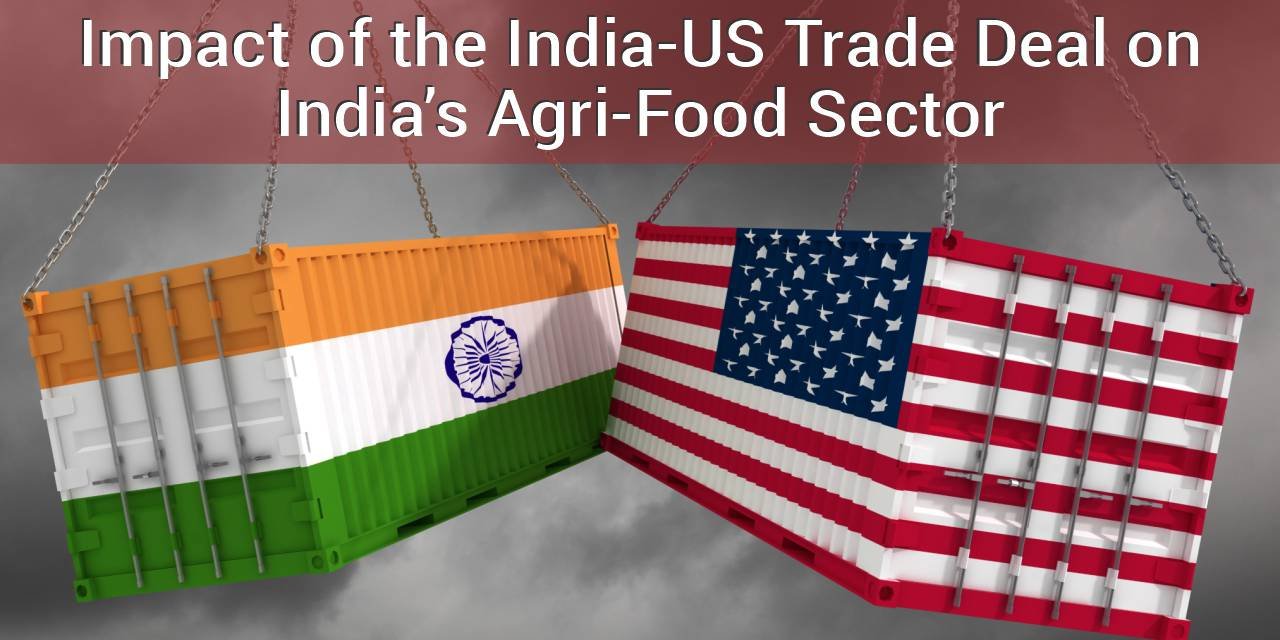
The 2026 India-US trade deal opens agricultural markets, raising concerns over competitiveness, subsidies, and farmer incomes in India. Rajat K Baisya provides an in-depth analysis of this trade deal and its impact on Indian agriculture, food processing, and farmer competitiveness.
India’s 2026 Trade Agreements with the EU and the US
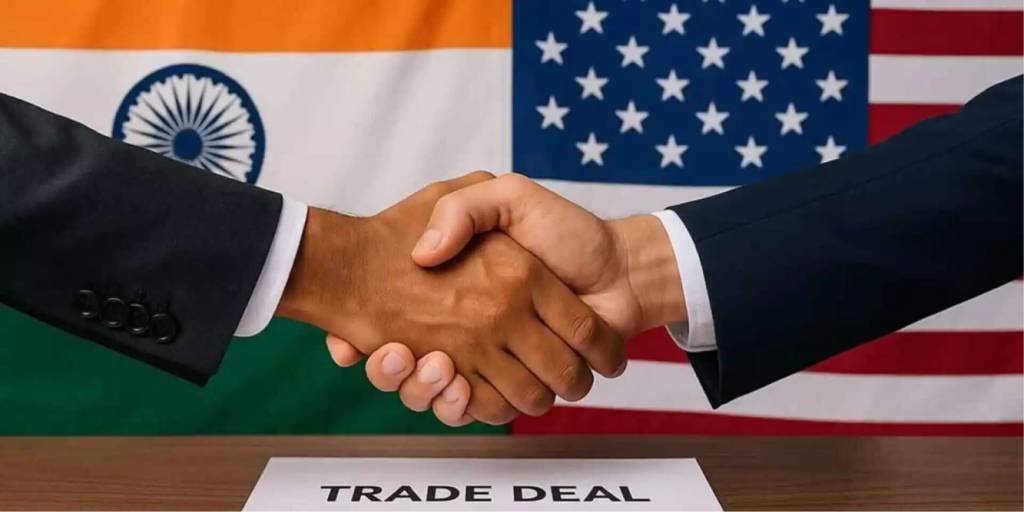
India signed a Free Trade Agreement (FTA) with the EU on 27th January 2026 and a trade deal with the US on 9th February 2026. Government expedited the FTA with the EU to contain the adverse impact on India arising out of Trump’s 50% duty on Indian goods to be exported to the US.
But when India signed an FTA with the EU, a few days later, Donald Trump announced the Indo-US trade deal, reducing the tariff from 50% to 18% with multiple conditions. Two important agreements with far-reaching and longer-term impact were signed hurriedly. The US-India deal appeared to be pre-decided and imposed on us. This agreement has a long-term and wide-ranging impact on Indian agriculture and food processing sector across a range of products.
India exports around USD 5.5 billion worth of food and agricultural products, and imports around USD 1.5 billion of select food items from the USA every year. It is worth noting that Indian food product exports to the US market require strict compliance with US FDA regulations, including Import-Export Codes (IECs).
Key Agri-food Products in India-US Food Trade
The food items that India exports to the US include largely marine products, which constitute about 46% of the total export, spices, rice (largely basmati), cashew, fruits like mango and guava, vegetables, tea, coffee, and essential oils. The recent trade deal provides zero duty for several Indian products including tea, coffee, coconut products and spices. Against that US exports to India products like almonds, pistachio, cotton, soyabean oil, fresh fruits like apples and ethanol. India is a growing market for US agricultural products with significant increase in demand in products like soyabean oil. However, US is pushing for higher exports of wheat, corn (maize) and fruits to narrow down the deficit. The recent deal involves reducing the tariff to zero allowing market access to US crops.
The deal is part of a larger USD 500 billion, 5-year goal, when India’s total exports to the US during 2024-25 were US$ 72.5 billion, growing at a rate of 5.85%, and total imports were US$ 43.92 billion, growing at a rate of 13.87%. India has always had a positive trade balance with the US in bilateral trade. Whereas, with China, India is a net importer. In FY 2024-25 India’s imports from China surged to a record high of approximately US$ 113.5 billion driven by electronics and machinery while exports remained very low at around US$ 14.2 billion only.
Why the New Trade Deal Matters for Indian Agriculture
By opening up the Indian agricultural sector to the US, which was never done earlier, Indian farmers have been exposed to an unequal challenge of very competitive farm produce from the USA. As such, the trade deal between the US and India has significant implications for the Indian agricultural sector. The US has 1.9 million farmers with an average farm size of 466 acres.
In sharp contrast, India has 150 million farmers, each owning only 1.8 acres of land. And large numbers of farmers in India are small and marginal farmers with holdings of less than 1 acre. In the US, farming is completely mechanised, including sowing, pre-harvest and post-harvest activities, and storage and warehousing practices. And in contrast, in India, it is completely manual, engaging large numbers of migrant labourers.
The Subsidy Gap Between American and Indian Farmers
Additionally, farmers in the US receive high-value direct payments, insurance, and disaster aid upto to US$ 30,000 (Rs. 2.7 lacs) per farmer per annum. Top commodities receiving subsidies in 2024 included corn (3.2 billion US$), soyabean (1.9 billion US$), wheat (960 million US$), pasture and forage (741 million US$) and cotton (998 million US$). Against that, India provides input-based subsidies (fertilisers, electricity, irrigation) for over 100 million farmers, with direct income support (PM-Kisan), amounting to about Rs. 6000 (US$ 66) per farmer per year. Indian farmers receive subsidies of Rs. 6000 per year, while American farmers receive subsidies of Rs. 2.7 lacs per farmer per year.
These disparities definitely put Indian farmers at a disadvantage regarding the cost of the farm produce. With free access, US farmers will dump stock at a lower cost to the peril of the Indian farmers. As US farmers have a competitive edge in global trade, India always used a high tariff on an average 39% to protect its farmers. The India-US trade deal has undermined that protection and exposed our farmers to an uncertain future.
Indian agricultural output is thus not competitive in the global market. As such India’s share of food and agricultural products in global trade still stands at 2.2 %. With the new India-US trade deal, India’s global trade in food and agriculture is destined to come down unless some mechanism for the protection of the interests of the Indian farmers is found.
Tariff Reductions and Market Access for US Crops
In the deal, phased elimination of tariffs over a period of 10 years for the food processing industry, including coconut oil, castor oil, and cottonseed oil, lard, stearin, modified starches, peptones, and various plant parts, has been provided for. But this will not have any significant impact on the performance of the processed food industry.
The recent trade deal with the US is part of a larger US$ 500 billion, 5-year goal, with the US pushing for free-market access in the agriculture sector. There is a distinct possibility that the Indian market could be flooded with cheaper food and agricultural products from the US, posing a serious problem for Indian farmers. The question remains whether India can export its agricultural produce to other countries; the probability of that happening is going to be low.
Impact on Dairy, Poultry, Soybean, and Maize Farmers
The deal allows imports of sorghum, soybean oil, and Dried Distillers Grains (DDGs), which could impact Indian soybean and maize farmers. Dairy and poultry farmers are likely to get impacted although India will benefit in terms of cheaper feed imports from the US. But the lower price of dairy products from the US can offset the slight advantage of cheaper imported feed.
The sensitive sectors, like our dairy, poultry, wheat, and rice, have now been thrown open to competition without a level playing field. The agreement allows for the import of US-produced Distillers Dried Grains with Soluble (DDGS) and red sorghum, which could impact the domestic feed market. The Indian government may need to negotiate safeguards to mitigate the impact on domestic farmers.
Trade Balance and the US Strategy to Reduce India’s Surplus
The deal also reduces import duties on products like almonds and apples. The impact of the trade deal is likely to change the current trade balance with US. Trump has negotiated the deal keeping in mind to neutralise India’s favourable trade balance with US in agricultural sector. In addition, this sector will have an indirect impact of increased fuel and power costs.
Critics and political parties have expressed concern about the deal’s potential to negatively affect the incomes of Indian farmers, with some calling it a compromise on the interests of Indian farmers in particular and of the agricultural sector in general.
The 2026 India-US trade deal impacts Indian agriculture through reduced tariffs on US products such as walnuts, blueberries, and cranberries, while opening markets for US soybean oil, DDGS, and poultry. The trade deal raises concerns about competition for smallholding farmers and potential food safety issues posed by imported, potentially genetically modified (GM) products.
Future of Indian Agri-food Sector Under New Trade Regime
The 2026 India-US trade deal thus brings a calibrated opening up of agricultural markets in India to US farmers and processors. India is self-sufficient in food production, except for edible oil and pulses and our farmers have always supported the country by showing consistent growth in production.
Even during the pandemic, the Indian agriculture sector delivered 3.5 % growth while all other sectors reported declines. The India-US trade deal is definitely not in the interest of our farmers and they have definite reasons and concerns to be unhappy.
The author is the Chairman of Strategic Consulting Group and a former Professor and Head of the Department of Management Studies at IIT Delhi.

Have a news or topic to share with industry? Write to us editorial@pfionline.com